
SmartAds
|
Media: DigitalThe History of Advertising: From Ancient Papyrus to Modern Campaigns
The history of advertising is a fascinating journey from primitive posters and town criers to today’s data-driven digital campaigns. Understanding this evolution is valuable for marketers, brands, and agencies because it reveals the advertising strategies and techniques that have succeeded over time. We’ll explore how advertising began, the key milestones (like the Golden Age of Advertising and the rise of TV and outdoor ads), and what the current advertising landscape looks like. This deep dive will include data, trends, and case studies — and even perspectives from SmartAds — to show why mastering advertising’s past can power smarter marketing tomorrow.
Outline
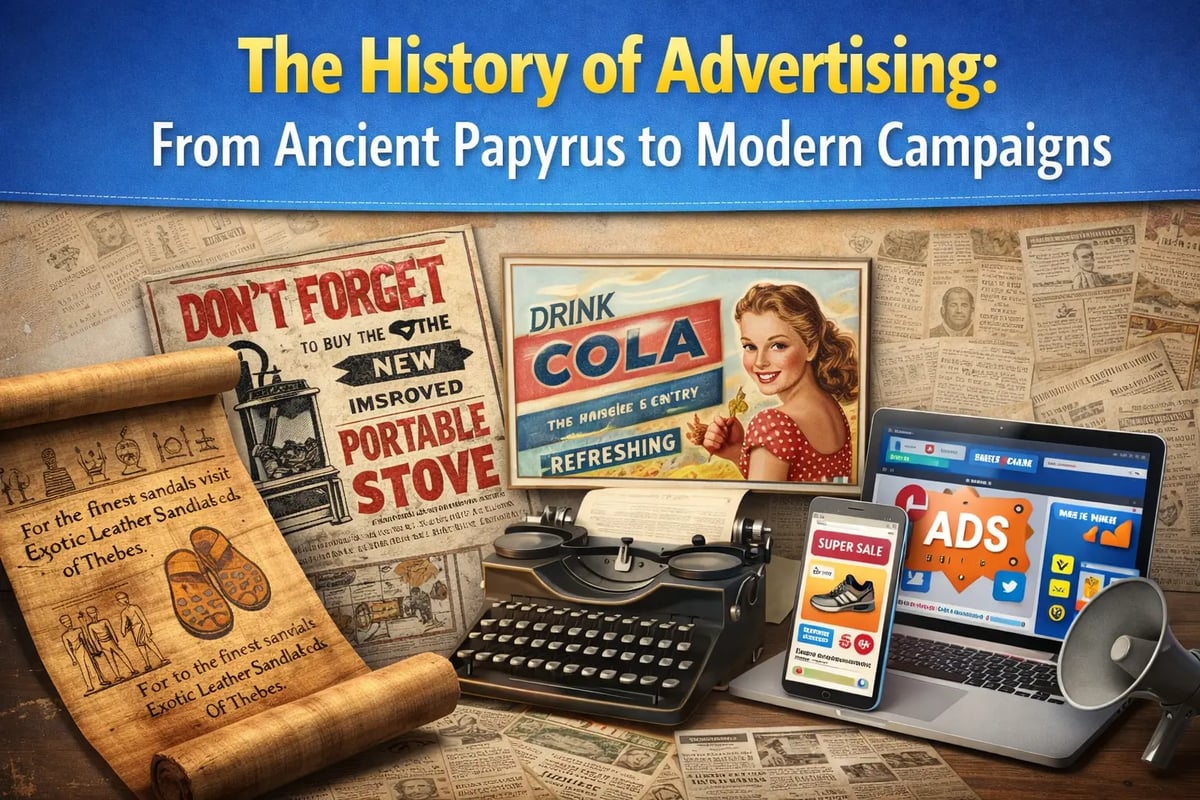
The history of advertising stretches back to ancient civilizations. Early ads took many forms — from papyrus scrolls to wall paintings — as merchants sought to inform and persuade customers. Over centuries, new media transformed advertising: the printing press enabled print advertising (newspapers, posters, handbills), the 19th century saw the rise of the first advertising agencies in Europe and America, and the 20th century introduced radio advertising and television advertising. Each leap in technology expanded advertising’s reach and impact on the advertising industry. In short, advertising began with simple notices and evolved into a global business – an essential component of marketing that shapes consumer culture.
Advertising became a major economic force by the mid-1800s. By the early 20th century, agencies and clients realized the advertising world could sway public opinion and consumer behavior at scale. In this brief history of advertising, we see a pattern: new media (print, radio, TV, digital) constantly created new types of advertising, each requiring novel advertising strategies. Today, modern advertising is powered by data analytics and digital platforms, but its roots in storytelling, branding, and persuasive messaging run deep through history.
Advertising began as simple oral and visual messages. In pre-literate societies, merchants used town criers and symbols (like a boot or a barrel sign) to advertise their trade. One of the earliest advertising known examples is an 11th-century Chinese poster: a square sheet printed with a rabbit logo for a needle shop, now considered the “world’s earliest identified printed advertising medium.” Ancient Egyptians used papyrus to create sales messages and wall posters, and Greeks and Romans posted lost-and-found advertising on papyrus scrolls. Indian rock paintings (cave art) also served as an ancient advertising form, illustrating products and concepts in public spaces.
The concept of advertising really took hold once mass literacy and publishing arrived. In the 15th century, printing presses enabled print advertising: flyers, pamphlets, and eventually newspapers. By the 1600s, printed ads appeared in English newsbooks. A famous milestone was Johannes Gutenberg’s invention of moveable type (around 1440), which made publishing easier. One of the earliest newspaper ads was in the New York Gazette in 1729. As commerce grew, ads for everything from insurance to coffee popped up in newspapers and magazines. This printed history shows that advertising began centuries ago as merchants sought ways to distinguish their products and reach wider audiences.
Print advertising was the foundation of the advertising industry. By the 1800s, newspapers and posters were the main advertising media. Early advertising was often text-heavy. Ads might read like classified notices or product descriptions. The first fully-designed advertising posters emerged in the 19th century, featuring colorful graphics to capture attention. For example, lithographic poster art (the famous “Bear Beer” or “Moulin Rouge” posters) showed the power of combining advertising content and art.
The United States saw its first advertising agencies in the 1840s. William Taylor’s 1786 London office is credited as history’s first ad agency, and in 1841 Volney B. Palmer started the first U.S. agency in Philadelphia. These agencies primarily sold newspaper space. Later in the 1800s, agencies like N.W. Ayer & Son in New York became full-service advertising agencies, creating copy, designing ads, and planning campaigns. N.W. Ayer, founded in 1869, is famous as an early example: it sold clients “complete campaigns,” not just ads. By the late 1800s, the advertising industry had professionalized; advertising agencies were publishing their own periodicals, holding conferences, and forming associations such as the American Association of Advertising Agencies (the 4A’s) in 1917. This growth of agencies and cooperative groups helped shape advertising standards and fostered shared strategies for print and newspaper advertising.
The Golden Age of Advertising refers to the post-World War II era (roughly 1940s–1960s) when advertising creativity and spending soared. Television’s arrival was key: “the coming of television in the 1950s dramatically enlarged the arena for advertising,” notes advertising historian Charles F. Adams. During this time, American families gained more leisure and buying power. Advertisers launched iconic campaigns and slogans (some coined by early pioneers, e.g. “Be all you can be” or “Reach out and touch someone”). Agencies grew in size and influence, often being called the “Mad Men” era for the aggressive creativity and male-dominated culture of 1950s NYC agencies. In this “advertising age,” agencies leveraged psychology and storytelling in print, radio, and TV campaigns. Journalist Vance Packard’s 1957 book The Hidden Persuaders exposed the psychological advertising techniques used, noting advertisers tapped into eight “compelling needs” (like security, vanity, etc.) to sell products. Though controversial, this highlighted how much ad agencies used emerging research (almost a precursor to modern advertising research) to craft messages.
This era also saw industry self-regulation begin. With powerful new media came scrutiny. For example, tobacco and food ads began facing public criticism for promoting unhealthy products and unrealistic ideals. (Indeed, by the 1970s certain ads “came under heavy pressure” from new laws – e.g. U.S. TV bans on cigarette advertising in 1971). Social norms evolved, but the late 1940s–60s remain the textbook example of advertisers wielding full creative freedom. The golden age cemented principles still taught today: a strong advertising message, memorable slogan, and strategic media choice. It’s no accident Ad Age magazine (originally Advertising Age) was founded in 1930; by mid-century it was preaching the gospel of advertising’s role in the economy. In essence, this period transformed advertising into a glamorous profession and proved the power of large-scale, multi-platform campaigns.
By mid-20th century, television advertising and radio advertising brought products directly into homes. Advertising and marketing budgets ballooned for these new media. Television ads became particularly influential: as TV ownership surged, brands poured money into short commercials. This era also solidified the advertiser’s ROI-driven mindset. SmartAds puts it plainly: “Maximizing conversions, minimizing costs – that’s SmartAds”, echoing the mid-century push to use TV/radio to reach the right customers efficiently.
Radio advertising actually predates TV. In the early 1920s, radio broadcasters realized they needed revenue. AT&T’s WEAF station in New York aired the first paid radio commercial on August 28, 1922 – a simple spot selling an apartment complex. By the late 1920s, most stations ran live reads or jingles, often sponsoring entire programs (think The Kraft Music Hall). During radio’s own “golden age,” ads featured upbeat announcers and catchy tunes. Even today, radio remains a paid advertising channel – though it now shares time with podcasts and streaming.
Television took it further. After World War II, Americans rapidly adopted TV sets. By the 1950s, major consumer goods and even political campaigns relied on TV spots. This was illustrated when Ad Council campaigns promoted Americanism in the Cold War. TV’s visuals amplified advertising techniques; colorful ads for cars, cosmetics, and food reached nationwide audiences. The advertising business on TV became a showcase of creativity (think iconic 1960s ads like the VW “Think Small” campaign by DDB). However, TV’s dominance also prompted new constraints: as the note of caution in the 1970s, TV took “the woods are full of opportunists…when the scent of profit comes down the wind”. By the 1980s, cable TV introduced new venues (MTV music videos, QVC shopping, etc.), and advertisers began tracking ratings carefully to guide TV buys.
Throughout, advertising agencies adapted. They developed television-specific skills (storyboarding, production) and synced campaigns across radio, TV, and print. The term ”broadcast media” came to mean radio and TV ads collectively. Today we often still call TV and radio spots ”ads” separate from digital or social media. In summary, broadcast advertising cemented mass marketing – reaching millions and defining how brands speak. Yet behind the scenes, core principles stayed constant: know your audience and craft a compelling message for them, whether via print copy or TV commercials.
Outdoor advertising (often called Out-of-Home or OOH) has always been part of the mix. In history’s early days, outdoor signs served local marketing: medieval guild signs, painted carriage ads, roadside posters. By the 1800s, lithographed posters plastered on city walls promoted products and events. 19th-century outdoor ads included circus billboards and “Wyoming Whiskey” cowboys on barns. The 20th century brought billboards along highways, turning travel into advertising opportunities. Modern outdoor advertising uses huge digital billboards, transit posters, and even skywriting.
Outdoor ads are valued for reach and brand reinforcement. For example, LED billboards in Times Square or moving freeway posters achieve large-scale advertising exposure. Nielsen research finds that adding outdoor can boost overall campaign reach dramatically (often 5-10% on top of online and TV) and drive recall. Outdoor also tends to be less targeted but highly visible: taxi-top screens, shopping mall banners, and airport ads catch people in transit.
Importantly, outdoor helped launch famous campaigns. Coca-Cola’s early Santa image (pioneered by Coca-Cola print ads) became a billboard staple. In India, the rapid rise of billboards in the 2000s mirrored economic growth. (Even today, advertising in India blends traditional outdoor with surging digital channels.) Across the globe, the large posters of old have evolved into digital screens and interactive bus shelters. Even with digital growth, outdoor remains a key type of advertising because it’s hard to skip a giant poster on your commute. Innovative uses include augmented reality bus ads or location-based mobile retargeting triggered by outdoor. But the principle is constant: eye-catching visuals (the “poster” legacy) placed where people gather.
Despite its long history, outdoor advertising continues evolving (for instance, out-of-home now involves programmatic digital buys). It’s also often the first medium noted in discussions of advertising strategies — think of it as “advertising with newspapers on the street.” Whether hand-painted or LED-lit, outdoor ads remind us that people buy products they see and remember, making the advertising message enduring.
The advent of the internet radically changed modern advertising. The shift from one-way broadcast to interactive digital media is arguably the biggest evolution ever. Today’s marketers use a blend of paid advertising, SEO content, social media, and email to reach consumers. “Advertising and marketing” have merged: targeting, personalization, and analytics are now central.
Digital advertising includes search ads, display banners, social media ads, and video pre-rolls. The International Journal of Advertising notes this era is defined by data-driven targeting. For example, programmatic platforms use digital advertising technologies (ad servers, real-time bidding, demand-side platforms) to deliver the right ad to the right person at the right time. SmartAds emphasizes this ROI focus: “We create and run PPC campaigns that maximise conversion rates and ROI”. Targeting grew so precise that marketers track cookies and user behavior; behavioural targeting and retargeting are now common practice.
New advertising techniques like native ads (ads designed to blend with content) and influencer marketing show the field’s ingenuity. Interactive ads let users click, swipe, or even try augmented-reality filters. Mobile advertising is a big part of this – smartphones serve as personal ad platforms. We’ve also seen “advergames” (ads in games), shoppable videos, and other novel formats. In short, digital’s strength is in combining creative content with measurable metrics. Data analytics allow split-testing of headlines and tracking advertising spending vs. performance in real time, a far cry from traditional broad campaigns.
Even so, the underlying psychology is the same: appeal to emotions, solve needs, or offer social proof. Some digital creatives take lessons from the past: clever copywriting or humor, reminiscent of old print ads. But digital budgets dwarf those of print; global digital ad spend is projected to keep rising. The challenge today is noise and choice – consumers skip ads more easily. This has pressured the industry to innovate continuously. Indeed, as one report notes, advertising spend has increased dramatically in absolute terms in recent years, even as its share of GDP remains around 2-3%. Marketers now use data science to refine advertising messages across channels.
In sum, modern advertising techniques involve campaigns, personalized content, and constant measurement. Traditional agencies had to adapt: many now include digital specialists (often called a full-service advertising agency model) or outsource to ad tech firms. The result is an advertising business where marketing history (like Duke University’s archives) informs new strategies – combining centuries of experience with cutting-edge tools.
No history of advertising is complete without ad agencies and trade groups. Advertising agencies (or ad agencies) grew from small newspaper agents to giants like Ogilvy or McCann. These advertising agencies offer services from creative design to media planning. The term “ad agency” itself dates to the 1800s. Today, they handle digital campaigns as well as old-school TV and outdoor buys. SmartAds operates as a platform to place ads across digital channels – an example of how agencies have become technology-powered.
Agencies often join professional associations for standards and advocacy. In the U.S., the American Association of Advertising Agencies (4A’s) was founded in 1917 to strengthen the advertising business. (It started as the Associated Advertising Clubs of the World.) By 1928, 4A’s had helped legitimize advertising as a vital industry; as 4A’s first president noted, he took the ad industry from “a not-so-highly-regarded corner of business to a crucial part of the economic ecosystem”. Today the 4A’s has 600+ member agencies overseeing most U.S. ad spend. In India and elsewhere, similar organizations (the Advertising Agencies Association of India, for example) set codes of ethics and track advertising standards.
Industry journals also played roles. Ad Age magazine (nicknamed “Advertising Age”) was founded in 1930 to report on marketing developments. Even academics study advertising – e.g., the International Journal of Advertising publishes research on advertising history and effectiveness. In fact, universities like Duke have entire collections on marketing history and advertising archives, underscoring advertising’s significance.Agencies themselves became crucial clients for brands. They would execute complete advertising campaigns for their customers – from concept to media buy. Over time, some agencies specialized (e.g., digital-only, PR, or media planning), but many still call themselves full-service advertising agencies. They might say they handle “advertising and promotion,” reflecting that advertising is one part of the marketing mix (alongside sales promotion, direct marketing, etc.).
In recent years, AdTechcompanies and new agency models (like performance marketing firms) have shaken up the traditional agency world. Still, agencies and trade associations ensure the field of advertising has shared knowledge and ethics. For example, industry-wide standards limit tobacco advertising (banned on broadcast media) or regulate claims in sex in advertising. Agencies collaborate to keep advertising effective and credible.
Tracing the evolution of advertising reveals patterns. Over centuries it has been a form of paid advertising that grew alongside media. Whether in the bustling bazaars of antiquity or the mobile internet era, the role of advertising has been to inform and persuade potential customers. Its concept has always revolved around raising awareness and driving sales, although methods have varied.
Even as mediums changed, one statistic shows the stability of ad spending: from 1925 to 1998, U.S. advertising outlays remained around 2–3% of GDP. This suggests that while ad techniques shifted (from newspaper and posters to internet and mobile), businesses consistently invest a similar portion of revenue into advertising, trusting its business impact. In fact, global ad spend is expected to exceed $1 trillion soon, with about half captured by the five big tech platforms (Google, Facebook, Amazon, Alibaba, ByteDance). This shows how global advertising has become dominated by digital giants, a far cry from the days of local print classifieds.
Case studies illuminate key trends. For instance, Nielsen found that adding billboards to TV campaigns raised reach and ROI. Or a modern example: Nike’s 2018 Bet app campaign combined a TV ad with social and mobile, showing how campaigns now span channels. Brands today focus on advertising content that tells a story or creates shareable experiences. The “empowerment” messaging in many ads (even by agencies that emphasize creative storytelling) ties back to mid-century ideas of appealing to consumers’ needs and values.
Looking back, advertising’s history shows innovation born of necessity. When newspapers first sold space, ads were simple text. When radio needed funding, companies sold the first radio ads in 1922. When the internet offered metrics, advertisers learned to optimize in real-time. Each era has lessons: clarity, creativity, understanding the lie behind successful advertising (emotional truth), and respecting changing norms. For example, sex in advertising has proved attention-grabbing but risky if overdone, leading to self-regulation (as with tobacco or explicit content).
Today’s advertisers must master multiple forms of advertising and media. They split budgets among TV, outdoor, print, digital video, social ads, and more – a mixed advertising media approach. Some trends like interactive or experiential ads promise more engagement. The future of advertising hinges on personal data privacy laws, AI-driven content, and newer platforms (like VR). But as SmartAds puts it, the constant goal is efficiency: “high ROI… ads on various platforms… conversion rates”SmartAds. In essence, advertising has evolved technologically, but it remains a conversation between brands and buyers that began millennia ago.
Looking ahead, many experts highlight data and technology. Digital advertising technologies will become more advanced: think AI-driven creativity, programmatic connected-TV ads, and even AI-written ad copy. Privacy changes (like ad blockers or data restrictions) pose challenges that the industry is adjusting to, while new measurement standards (for example, trust frameworks in programmatic advertising) emerge.
One prediction is that interactive advertising will grow: ads that respond to voice commands or augmented reality experiences (like trying on glasses in your camera) will become mainstream. Another is the blending of advertising and content – native advertising and influencer partnerships will expand, so that consumers feel like they are watching content rather than being sold to. Also, as mobile advertising inevitably rises (with billions of smartphone users), location-based ads and ephemeral content (e.g., Stories on social apps) will be key.
Data from WARC suggests that advertising budgets are resilient. After pandemic dips, global ad spending has bounced back. Social media and retail media networks (ads on shopping sites) are expected to lead growth. Traditional media like linear TV are shrinking share, but still large. So the advertising landscape is increasingly digital and fragmented, but not entirely abandoning legacy media. As budgets shift, agencies will need to integrate these channels holistically.
To prepare, marketers should remember the lessons from history: focus on creative advertising strategies backed by data. Innovate (for example, using shoppable ads or programmatic OOH), but also respect the purpose of advertising — to connect with people. In bullet points, the key takeaways are:
By learning advertising’s history — from the world’s earliest identified printed ad in ancient China to today’s digital marketplaces — marketers can apply time-tested principles in new ways. As SmartAds’s motto suggests, the goal is always maximizing impact while minimizing waste. In doing so, the story of advertising continues its exciting evolution.
What was advertising like in ancient times :Merchants used papyrus ads and wall paintings in Egypt, Greece and India. These primitive signs and town criers are the earliest advertising forms.
Who invented advertising: There’s no single inventor, but early pioneers include William Taylor (1786, London) and Volney B. Palmer (1840, Philadelphia) who started the first ad agencies.
What is the Golden Age of Advertising:It refers to the 1950s-60s boom in creative ad campaigns, fueled by TV and booming postwar economies.
How have digital ads changed the industry? Digital ads introduced targeting and analytics. Techniques like programmatic buying and social media ads now let brands tailor messages in real-time.
What’s the future of outdoor advertising:Outdoor will use more digital screens and data (e.g., programmatic OOH). But its core remains the same: large displays in public spaces to build brand awareness.


