
SmartAds
|
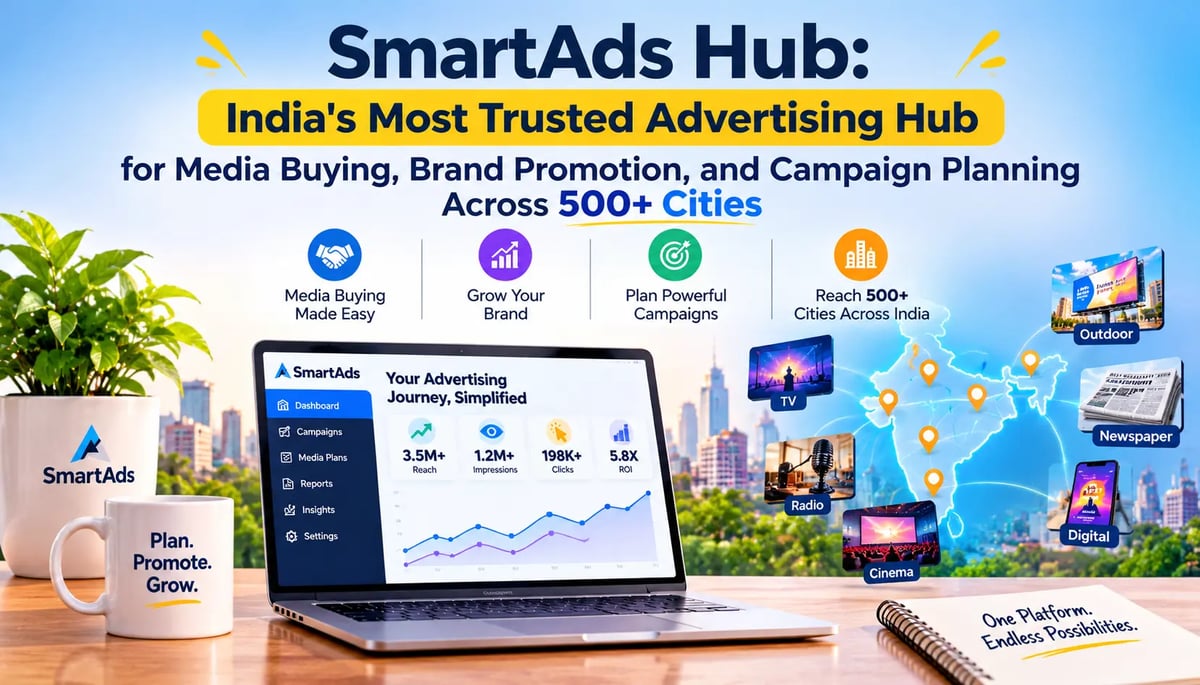
Media: DigitalSmartAds Hub: India's Most Trusted Advertising Hub for Media Buying, Brand Promotion, and Campaign Planning Across 500+ Cities
Most advertisers in India are still planning campaigns the way they did a decade ago — one medium at a time, one vendor at a time, with no unified view of how their rupees are actually performing across the mix. The India advertising market crossed ?1.1 lakh crore in 2024, according to the FICCI-EY Media and Entertainment Report, and yet the majority of brand managers we speak to cannot tell you, with any confidence, what their blended cost per impression looks like across television, outdoor, and digital combined. That is the problem SmartAds Hub was built to solve.
SmartAds Hub is not a software platform or a self-serve ad network in the conventional sense; it is the centralised advertising intelligence and campaign execution ecosystem that SmartAds.in has built over years of working with brands across 500-plus Indian cities. Think of it as the operational and intellectual nerve centre of everything SmartAds does — the place where media planning expertise, rate intelligence, format knowledge, vendor relationships, and campaign data all converge into something genuinely useful for advertisers. When a brand manager walks into a conversation with our team, they are not talking to a vendor pushing inventory; they are accessing an advertising hub that has already done the groundwork on rates, reach, and format suitability across every major media category in India.
What makes SmartAds Hub India particularly valuable is the breadth of its coverage. We work across television, cinema, outdoor, newspaper, magazine, radio, and digital — which means a brand does not have to manage six separate agency relationships to run a 360 degree advertising campaign. The hub model consolidates that complexity into a single planning interface, which is something most mid-sized advertisers in India have never actually experienced. A retail client in Pune came to us after spending two years managing their outdoor and digital spends through different vendors; within one quarter of consolidating their media buying through SmartAds Hub, they reported a reduction in blended CPM of roughly 22 percent — not because we negotiated dramatically different rates, but because we eliminated duplication and identified significant overlap in their audience targeting that neither vendor had flagged.
The advertising hub model also creates something that individual channel buys rarely produce: a unified performance view. At SmartAds, we always tell our clients that the single most dangerous thing in media planning is optimising each channel in isolation, because what looks efficient on paper for television might be cannibalising the reach you are already buying on digital — and without a hub view, you will never know. SmartAds Hub aggregates campaign data across formats, which allows our planning team to make mid-flight adjustments that a fragmented vendor setup simply cannot support.
The honest answer is: every format that matters in the Indian advertising ecosystem, and a few that most agencies do not even bother with. SmartAds Hub covers television advertising across national and regional channels, cinema advertising through multiplex chains and single-screen networks, outdoor advertising including hoarding advertising, billboard advertising, transit advertising, and airport advertising, print advertising across newspapers and magazines, radio advertising on both FM and community stations, and the full spectrum of digital advertising from programmatic display to social media to connected TV. That is not a claim we make lightly; it reflects the vendor network and rate intelligence we have built over years of active media buying across PAN India campaigns.
On the digital side, SmartAds Hub works with the major ad networks and platforms that actually move the needle in India — which includes Google Ads, Meta Ads across Facebook and Instagram, programmatic advertising through platforms like Display & Video 360 and The Trade Desk, and India-specific digital properties like ShareChat, Dailyhunt, MX Player, and Zee5, which collectively reach audiences that are simply not accessible through global platforms alone. The Dentsu E4M Digital Advertising Report has consistently highlighted the growth of vernacular digital inventory, and our experience confirms that brands ignoring regional language digital placements are leaving significant reach on the table — particularly in states like Maharashtra, Tamil Nadu, and West Bengal, where vernacular advertising on platforms like ShareChat delivers cost per impression figures that are, frankly, a fraction of what equivalent Hindi or English inventory costs.
For outdoor specifically, SmartAds Hub covers hoarding advertising and billboard advertising in metro markets like Mumbai, Delhi, and Bangalore, but the more interesting opportunity — and the one most brands are underutilising — is the OOH advertising inventory we have mapped across Tier 2 cities India. A city like Jaipur or Lucknow or Coimbatore has outdoor inventory that delivers exceptional brand visibility at rates that would be considered laughably cheap by Mumbai standards; the challenge has always been that no single agency had the vendor relationships and rate intelligence to make that inventory accessible at scale. SmartAds Hub has spent years building exactly that infrastructure.
Campaign planning through SmartAds Hub starts with a conversation that most advertisers find surprisingly different from what they have experienced elsewhere — because we begin with the audience, not the medium. Our media planning team asks questions about purchase behaviour, consumption habits, and geographic concentration before we ever discuss ad formats or ad rates; this approach, which sounds obvious in theory, is genuinely rare in practice. What we have found is that most brands come to us with a medium already in mind — "we want to do outdoor in Delhi" or "we need a digital campaign" — and our first job is often to gently challenge that assumption with data.
Once the audience and objective are clear, the SmartAds Hub planning process moves into format selection and budget allocation. This is where the hub's consolidated rate intelligence becomes genuinely useful; because we are actively buying across television, outdoor, print, and digital simultaneously for multiple clients, our rate benchmarks are current in a way that published rate cards rarely are. Ad rates for outdoor in Mumbai, for instance, fluctuate significantly based on seasonality, political events, and IPL advertising cycles — which means a rate card from six months ago could be misleading by 30 to 40 percent in either direction. Our team tracks these movements in real time, which allows us to advise clients on timing their bookings to capture the best value.
The ad booking process itself, once the plan is finalised, is handled entirely by SmartAds — which means the client does not have to manage purchase orders, creative specifications, or proof of performance across a dozen different vendors. Campaign management is centralised, which eliminates the coordination overhead that typically consumes a significant portion of a brand manager's time on multi-format campaigns. One automotive brand we worked with estimated that consolidating their media buying through SmartAds Hub saved their internal team roughly 15 hours per week in vendor coordination — time that was redirected into creative strategy and performance analysis, which is where brand teams should actually be spending their energy.
The India advertising market is structurally fragmented in a way that is genuinely unusual by global standards. A brand running a PAN India campaign might be dealing with 50-plus individual media owners across print, outdoor, and radio alone — each with their own rate cards, creative specifications, booking deadlines, and proof-of-performance formats. This fragmentation is not accidental; it reflects the linguistic, geographic, and cultural diversity of a country where a campaign that works in Mumbai might be entirely irrelevant in Chennai. The benefit of a centralised advertising hub is not that it simplifies this complexity away — it is that it makes the complexity manageable without losing the nuance.
Smart advertising, as we practice it at SmartAds, means using consolidated data to make better decisions rather than just faster ones. When a brand's television advertising, outdoor advertising, and digital advertising are all planned and bought through a single hub, the planning team can see — in real time — where audiences are being reached multiple times and where they are being missed entirely. This kind of cross-channel frequency management is something that the GroupM TYNY Report has identified as one of the primary drivers of media efficiency improvement in Indian campaigns, and our experience confirms it; brands that consolidate their media buying through SmartAds Hub consistently report better ROAS figures than they achieved when managing channels separately, even when the total budget remains unchanged.
There is also a negotiating advantage that comes with scale. Because SmartAds Hub aggregates buying across multiple clients and multiple formats, we carry volume commitments to media owners that individual advertisers simply cannot match — which translates into rate advantages that are passed directly to our clients. To be honest, this is one of those benefits that is hard to quantify precisely because it varies by market and format, but the savings are real and they compound over time. A FMCG brand we worked with on a six-month PAN India campaign found that their effective outdoor advertising rates through SmartAds were somewhere between 18 and 25 percent below what they had been paying through direct vendor relationships — a difference that, on a campaign of that scale, amounted to several lakhs in recovered budget.
We get asked this question more often than almost any other, and the honest answer is that the ATL-BTL distinction matters far less than most textbooks suggest — what matters is whether your media mix is reaching the right people at the right moment in their decision journey. That said, the framework is useful for budget allocation conversations, so it is worth being precise about what each term actually means in practice. ATL advertising — which covers television, cinema, radio, and large-format print — is characterised by its mass reach and its relative inability to be precisely targeted; you are buying audiences in bulk, which makes ATL efficient for brand awareness but expensive for conversion-focused objectives.
BTL advertising, by contrast, is everything that touches a specific, defined audience in a specific context — which includes point-of-sale materials, experiential activations, direct mailers, trade promotions, and hyperlocal advertising formats. SmartAds Hub covers BTL advertising through our activation and experiential network, which spans retail environments, transit hubs, and residential communities across major Indian cities. The thing that most brands get wrong about BTL is treating it as a secondary channel — something you do after the ATL campaign has run. Our experience shows that BTL advertising, when planned in parallel with ATL, dramatically improves conversion rates because it intercepts the consumer at a moment of decision rather than simply building awareness from a distance.
TTL advertising — Through the Line — is the integrated approach that combines ATL reach with BTL precision, and it is, frankly, where most modern brand campaigns should be operating. SmartAds Hub is specifically designed to support TTL advertising because our planning infrastructure covers both ends of the spectrum simultaneously; a brand can run a national television campaign through SmartAds while also executing hyperlocal outdoor advertising and BTL activations in specific markets, all coordinated through a single campaign management framework. One D2C skincare brand we worked with ran a TTL campaign that combined Hotstar pre-roll advertising with transit advertising in Delhi metro stations and point-of-sale activations in modern trade — the combination produced a brand awareness lift that was, by their own measurement, roughly three times what their previous television-only campaign had achieved at a similar budget.
This is a question that deserves a direct answer rather than diplomatic hedging. There are other advertising portals and platforms operating in India — some focused on specific formats, some offering self-serve booking tools, some functioning primarily as rate aggregators. What distinguishes SmartAds Hub from those alternatives is not any single feature; it is the combination of format breadth, geographic depth, and active media planning expertise that sits behind every campaign.
A self-serve advertising portal can show you rate cards and let you book inventory online; what it cannot do is tell you that the outdoor site you are considering on the Western Express Highway in Mumbai is currently partially obstructed by construction, or that a particular regional television channel's viewership data from BARC has been trending downward for three consecutive quarters, or that the newspaper you are about to book has recently lost significant circulation in the districts that matter most to your brand. That kind of intelligence — which is what separates smart advertising from mechanical media buying — only comes from active market presence and genuine vendor relationships, which is what SmartAds Hub is built on.
SmartAds Hub India also covers geographic territory that most advertising portals simply do not reach. Operating across 500-plus cities means we have active vendor relationships and rate intelligence in markets that many agencies treat as afterthoughts — which is a significant advantage for brands that are serious about Tier 2 cities India and Tier 3 market penetration. The TAM AdEx data consistently shows that advertising spend in non-metro markets is growing faster than in the top six cities, and brands that establish presence in these markets early — before competitive clutter builds — tend to see significantly better brand visibility returns on their investment. SmartAds Hub is, to our knowledge, one of the few advertising hubs in India with the infrastructure to execute that kind of broad geographic coverage without the client having to manage dozens of local vendor relationships.
There is a persistent myth in Indian advertising that mass media is only for large brands with large budgets, and we have spent years actively working to dismantle it. The reality is that the India advertising market has more entry points for small businesses than it has ever had — particularly in outdoor advertising, radio advertising, and digital advertising, where minimum booking thresholds have come down significantly over the past five years. SmartAds Hub is specifically designed to make these entry points accessible to brands that are working with budgets in the range of a few lakhs rather than a few crores.
For startups and D2C brands specifically, the SmartAds Hub approach typically begins with a focused geographic strategy rather than a PAN India campaign — which is the right call for most early-stage brands. A startup in Bangalore with a monthly advertising budget of, say, five to eight lakhs can achieve meaningful brand awareness through a combination of outdoor advertising on key arterial routes, radio advertising on local FM stations, and digital advertising on platforms like Meta Ads and ShareChat — all coordinated through SmartAds Hub to avoid duplication and maximise reach efficiency. The cost per impression on this kind of hyperlocal advertising mix is often surprisingly competitive; a well-planned radio campaign in a Tier 2 city, for instance, can deliver reach figures that work out to a CPM somewhere in the range of ?40 to ?80, which compares very favourably to what the same brand would pay for equivalent reach through Instagram in the same geography.
What we tell small business clients, consistently, is that the biggest mistake they can make is spreading a limited budget too thin across too many channels. SmartAds Hub helps avoid this by providing a planning framework that prioritises depth of impact in a defined market over superficial presence across many markets — and by being honest with clients when a proposed campaign plan is not going to achieve meaningful results at the available budget. Frankly speaking, that kind of honest counsel is rarer than it should be in the Indian advertising industry, and it is something we consider a core part of what SmartAds Hub delivers.
The India advertising market in 2026 is being shaped by several forces that are genuinely new — not incremental evolutions of existing trends, but structural shifts that are changing how brands reach audiences and how media owners price their inventory. The most significant of these, in our assessment, is the acceleration of connected TV advertising in India, driven by the rapid growth of streaming platforms like Hotstar, Zee5, and MX Player, which are now delivering addressable television reach at scale. The Dentsu E4M Digital Advertising Report has flagged connected TV as one of the fastest-growing ad formats in India, and our experience with clients who have shifted a portion of their traditional television advertising budget into CTV placements confirms that the targeting precision and measurability of CTV represent a genuine improvement over linear TV buying for most brand objectives.
Programmatic advertising is the second major trend reshaping the SmartAds Hub planning framework. What was once a specialised capability available only to large advertisers with sophisticated technology stacks is now accessible to mid-sized brands through managed programmatic buying — which is how SmartAds Hub approaches it. We use programmatic advertising not as a replacement for direct publisher relationships but as a complementary layer that allows for precise audience targeting, real-time optimisation, and data-driven advertising decisions that direct buys cannot support. The integration of programmatic digital with traditional outdoor advertising — what the industry is calling programmatic DOOH, or Digital Out-of-Home — is particularly interesting; it allows brands to serve contextually relevant outdoor advertising based on real-time data signals like weather, time of day, and audience movement patterns.
IPL advertising continues to be a defining moment in the Indian advertising calendar, and SmartAds Hub has developed specific planning frameworks around IPL season that help brands maximise their participation without overpaying for the most obvious inventory. The thing is, most brands approach IPL advertising by competing for the same high-visibility spots — which drives prices to levels that are difficult to justify on pure reach efficiency grounds. Our approach is to identify the adjacency opportunities: the regional broadcast slots, the digital pre-roll on cricket content platforms, the outdoor advertising near stadium catchment areas — which deliver IPL-adjacent brand visibility at rates that are, in our experience, 40 to 60 percent more efficient than the marquee spots everyone else is fighting over.
OOH advertising in India is undergoing a transformation that most brand managers have not fully registered yet. The traditional model — book a hoarding, paste a creative, wait 30 days — is being replaced by a dynamic, data-informed approach to outdoor advertising that changes what brands can expect from the format. SmartAds Hub has been at the forefront of this shift, building a planning framework for OOH advertising that incorporates audience movement data, competitive site analysis, and creative effectiveness benchmarks that were simply not available to most advertisers five years ago.
The geography of OOH advertising in India is also shifting in ways that create real opportunity for brands willing to look beyond the obvious markets. Mumbai and Delhi-NCR remain the largest OOH markets by volume and by rate — a premium billboard advertising site in South Mumbai or Connaught Place in Delhi can command rates that work out to several lakhs per month, which is justified by the sheer volume of high-value audience exposure those sites deliver. But the more interesting growth story is in markets like Hyderabad, Pune, Ahmedabad, and the fast-expanding Tier 2 cities India cluster, where outdoor advertising inventory is growing rapidly and rates remain significantly below metro levels. SmartAds Hub has active vendor relationships across all of these markets, which means we can execute a genuinely national OOH campaign — not just a Mumbai-Delhi campaign with a few secondary markets added as an afterthought.
Transit advertising deserves special mention because it is consistently underestimated by brand managers who have not looked at the reach numbers carefully. Airport advertising, for instance, reaches an audience that is disproportionately high-income and high-influence; the cost per impression on airport advertising is higher than most outdoor formats, but when you index it against the purchasing power and decision-making authority of the audience, the efficiency argument becomes compelling. SmartAds Hub plans airport advertising across major Indian airports, including the IndiGo Airlines terminal environments where captive audience dwell times are among the highest of any advertising format in the country. Metro rail advertising — which spans Delhi, Mumbai, Bangalore, and a growing number of other cities — delivers similar captive audience dynamics at rates that are considerably more accessible for mid-sized advertisers.
The SmartAds Hub blog is, frankly, one of the most underutilised resources available to Indian marketers — and we say that not as self-promotion but as a genuine observation about how rarely brand managers seek out independent, experience-based media planning content in a market that is flooded with vendor-produced promotional material. The SmartAds Hub blog publishes content that is grounded in actual campaign experience: rate benchmarks from live market data, format comparisons based on real campaign performance, city-specific advertising guides that reflect current market conditions rather than theoretical frameworks.
The content categories that the SmartAds Hub blog covers span the full advertising knowledge hub spectrum — which includes media planning guides for specific formats (how to plan a radio advertising campaign, how to evaluate outdoor advertising sites, how to structure a programmatic advertising brief), market-specific guides covering advertising opportunities in cities from Mumbai and Delhi to Jaipur, Coimbatore, and Lucknow, and strategic content addressing questions that brand managers actually face in budget allocation meetings. We have found that the most-read SmartAds Hub blog content tends to be the pieces that include specific numbers — ad rates, reach benchmarks, cost per impression comparisons — because that kind of transparency is genuinely rare in Indian advertising publishing.
On top of that, the SmartAds Hub blog covers emerging format categories that most advertising portals in India have not yet addressed in depth — including influencer marketing integration with traditional media campaigns, performance marketing frameworks for D2C brands, and the growing category of vernacular advertising across regional language digital platforms. SmartAds Hub advertising tips content is specifically designed to be actionable for brand managers who are making real decisions with real budgets — not theoretical frameworks that sound impressive in a presentation but offer no practical guidance when you are sitting across from a vendor trying to negotiate a rate.
Media buying in India rewards preparation more than almost any other market in the world — because the rate variance between a well-prepared buyer and an unprepared one can be genuinely dramatic. Our SmartAds Hub media buying guide approach starts with a principle that sounds simple but is consistently violated in practice: never enter a rate negotiation without knowing what the inventory is actually worth. This means having current market benchmarks, understanding the seasonal demand curve for the format you are buying, and knowing enough about the specific vendor's inventory situation to understand their motivation to deal.
For television advertising, the key variables that determine rate efficiency are channel viewership (as measured by BARC data), daypart selection, and the relationship between your booking volume and the channel's available inventory. A brand that books television advertising in the three weeks before a major festival is competing against every other advertiser in India for the same inventory — which drives rates to levels that are, in our assessment, rarely justified by the incremental reach delivered. SmartAds Hub advises clients to consider pre-festive and post-festive windows, which deliver comparable viewership at rates that are somewhere between 20 and 35 percent lower than peak festive pricing.
For digital advertising, the media buying landscape is more complex because the variables are more numerous — which is both the opportunity and the challenge of the format. Google Ads and Meta Ads offer the most transparent auction-based pricing in the Indian digital advertising market, but the efficiency of your spend depends enormously on campaign structure, audience definition, and creative quality in ways that outdoor or print buying simply do not. SmartAds Hub manages digital advertising buying with the same rigour we apply to traditional media — which means setting clear cost per impression and ROAS targets before campaign launch, building in optimisation checkpoints, and being willing to reallocate budget mid-flight when the data indicates that a particular placement or audience segment is underperforming.
Q: What is SmartAds Hub and how does it help advertisers in India?
SmartAds Hub is the centralised advertising ecosystem of SmartAds.in — which is an integrated media buying and advertising agency operating across 500-plus Indian cities. Rather than functioning as a simple ad booking portal, SmartAds Hub brings together media planning expertise, live rate intelligence, vendor relationships, and campaign management infrastructure across every major advertising format in India. The practical benefit for advertisers is that they can plan, book, and manage campaigns across television, outdoor, digital, print, radio, and cinema through a single partner — which eliminates the coordination overhead of managing multiple vendors, provides access to consolidated rate advantages, and creates a unified view of campaign performance across channels. For brand managers who have previously managed media buying through fragmented vendor relationships, the experience of working through SmartAds Hub is genuinely different: the planning conversations are more strategic, the rate benchmarks are more current, and the campaign outcomes are more measurable.
Q: How can I book an ad campaign through SmartAds Hub?
Ad booking through SmartAds Hub begins with a briefing conversation — not a form fill or a self-serve interface — because our experience shows that the most important work in campaign planning happens before any inventory is booked. Our media planning team reviews the brand's objectives, target audience, geographic priorities, and budget, and then develops a recommended media mix with specific format recommendations and rate benchmarks. Once the plan is agreed, SmartAds handles all vendor communication, creative specification management, booking confirmation, and proof-of-performance collection on the client's behalf. The process is designed to be as frictionless as possible for the advertiser while maintaining the quality controls that protect campaign effectiveness. Brands can initiate the conversation through SmartAds.in, and our team typically responds with an initial planning framework within 48 hours of receiving a brief.
Q: What types of advertising media does SmartAds Hub cover?
SmartAds Hub covers the full spectrum of advertising media available in India — which includes television advertising across national and regional channels, cinema advertising through multiplex and single-screen networks, outdoor advertising encompassing hoarding advertising, billboard advertising, transit advertising, and airport advertising, print advertising across newspapers and magazines, radio advertising on FM and community stations, and digital advertising spanning programmatic display, social media, connected TV, and India-specific digital platforms. The breadth of format coverage is one of the defining characteristics of SmartAds Hub; most advertising portals in India specialise in one or two format categories, which means brands have to manage multiple vendor relationships to run a genuinely integrated campaign. SmartAds Hub consolidates all of this into a single planning and buying framework, which is particularly valuable for brands running 360 degree advertising campaigns where cross-channel coordination is critical to campaign effectiveness.
Q: Is SmartAds Hub suitable for small businesses and startups in India?
Absolutely — and this is a point we feel strongly about, because the assumption that integrated media buying is only for large advertisers is one of the most persistent and damaging myths in Indian advertising. SmartAds Hub works with brands across a very wide budget range, from startups allocating a few lakhs per month to large corporates running multi-crore annual campaigns. For smaller advertisers, the SmartAds Hub approach typically involves a more focused geographic strategy — concentrating budget in one or two markets rather than spreading it thin across the country — and a media mix that prioritises formats with lower minimum booking thresholds, such as radio advertising, digital advertising, and Tier 2 city outdoor advertising. The planning expertise that SmartAds Hub brings is, if anything, more valuable for smaller advertisers than for large ones, because the cost of a poorly planned campaign is proportionally much higher when the budget is limited.
Q: What is the difference between ATL, BTL, and TTL advertising on SmartAds Hub?
ATL advertising — Above the Line — refers to mass-reach formats like television, cinema, radio, and large-format print, which build broad brand awareness but offer limited targeting precision. BTL advertising — Below the Line — covers targeted, context-specific formats like point-of-sale materials, experiential activations, direct marketing, and hyperlocal advertising, which are more efficient for conversion-focused objectives but reach smaller audiences. TTL advertising — Through the Line — is the integrated approach that combines both, using ATL formats to build awareness and BTL formats to drive conversion, with the two working in a coordinated way rather than independently. SmartAds Hub is specifically designed to support TTL advertising because our planning infrastructure covers all three categories simultaneously; a brand can run a national television campaign alongside hyperlocal BTL activations in specific markets, all managed through the same campaign framework. In our experience, TTL campaigns consistently outperform single-category approaches on brand awareness, purchase intent, and conversion metrics — though the degree of improvement depends heavily on how well the ATL and BTL elements are coordinated in terms of messaging and timing.
Q: How does SmartAds Hub compare to other advertising portals like The Media Ant?
The most meaningful difference between SmartAds Hub and self-serve advertising portals is the nature of the service model. Self-serve portals are primarily rate aggregators and booking interfaces — they are useful for straightforward, single-format campaigns where the advertiser already knows exactly what they want to buy. SmartAds Hub is a managed service model, which means a team of experienced media planners is actively involved in every campaign — advising on format selection, negotiating rates, managing vendor relationships, and optimising campaign performance. This distinction matters most for complex, multi-format campaigns where the planning decisions have a significant impact on outcomes; for a brand running a PAN India campaign across outdoor, digital, and television simultaneously, the value of experienced planning counsel is difficult to overstate. SmartAds Hub also covers geographic territory that most advertising portals do not reach, with active vendor relationships across 500-plus Indian cities including Tier 2 and Tier 3 markets where self-serve inventory aggregation is limited.
Q: What are the advertising rates available on SmartAds Hub for digital and outdoor formats?
Ad rates vary significantly by format, market, and seasonality — which is why we are cautious about publishing static rate cards that can quickly become misleading. That said, we can share some indicative benchmarks from our current market intelligence. For digital advertising, programmatic display CPMs in India work out to roughly ?40 to ?120 depending on audience quality and placement context, while social media advertising on Meta platforms typically runs somewhere between ?80 and ?200 CPM for standard audience targeting. For outdoor advertising, a mid-size hoarding advertising site in a Tier 2 city like Jaipur or Coimbatore can be secured for somewhere in the ballpark of ?25,000 to ?80,000 per month, while equivalent visibility in Mumbai or Delhi would cost several times that figure. Radio advertising on a major FM station in a metro market typically works out to a cost per spot in the range of ?3,000 to ?15,000 depending on daypart and station reach. These are indicative figures; actual rates depend on specific market conditions, booking volume, and campaign timing — and SmartAds Hub provides clients with current market benchmarks as part of the planning process.
Q: Can I use SmartAds Hub to advertise in Tier-2 and Tier-3 cities in India?
This is one of the areas where SmartAds Hub has the clearest competitive advantage over most advertising portals and agencies. Our vendor network spans 500-plus Indian cities, which means we have active relationships with outdoor media owners, radio stations, local newspapers, and digital publishers in markets that most agencies simply do not cover. Tier 2 cities India — which includes markets like Jaipur, Lucknow, Coimbatore, Nagpur, Surat, Bhopal, and dozens of others — represent one of the fastest-growing segments of the India advertising market, and the brands that are establishing presence in these markets now are building brand visibility advantages that will be difficult for later entrants to overcome. SmartAds Hub can execute city-specific campaigns in Tier 2 and Tier 3 markets with the same planning rigour and vendor management that we apply to metro campaigns — which is something that most advertising portals, which are primarily metro-focused, cannot genuinely claim.
Q: How does SmartAds Hub help brands measure ROI and campaign performance?
Campaign performance measurement through SmartAds Hub is built around the specific objectives that are established at the planning stage — which means the metrics we track and report are tied to business outcomes rather than just media delivery statistics. For brand awareness campaigns, we track reach, frequency, and brand recall lift (where research budgets allow); for performance-oriented campaigns, we track cost per lead, cost per acquisition, and ROAS across digital channels. For traditional media formats like outdoor and television, where direct attribution is more complex, SmartAds Hub uses a combination of reach modelling, footfall data (where available), and brand tracking surveys to build a picture of campaign effectiveness that goes beyond simple delivery reporting. The TAM AdEx and BARC data that we access as active media buyers also allows us to provide clients with competitive context — showing how their share of voice compares to category competitors across specific formats and markets.
Q: What are the latest advertising trends covered in the SmartAds Hub blog for 2026?
The SmartAds Hub blog in 2026 is covering several themes that reflect genuine shifts in the Indian advertising market. Connected TV advertising and its implications for television campaign planning is a major focus, as is the growth of programmatic DOOH — programmatic Digital Out-of-Home advertising — which is beginning to change how outdoor advertising is planned and bought in Indian metro markets. Vernacular advertising across regional language digital platforms is another area of significant coverage, reflecting the rapid growth of non-English digital audiences in India. The SmartAds Hub blog is also covering the evolution of data-driven advertising in India, including the implications of cookie deprecation for programmatic buying strategies and the growing importance of first-party data in campaign targeting. IPL advertising planning guides, city-specific advertising market reports, and format-specific rate benchmarks are among the most consistently popular content categories on the SmartAds Hub blog.
Q: Does SmartAds Hub offer programmatic and digital advertising solutions?
Yes — and this is an area where SmartAds Hub has invested significantly in capability over the past several years. Our digital advertising offering spans the full range of programmatic and direct digital formats, including display advertising through programmatic platforms, video advertising on connected TV and YouTube, social media advertising across Meta Ads and other platforms, search advertising through Google Ads, and native advertising on India-specific digital properties like ShareChat, Dailyhunt, and MX Player. We manage programmatic advertising through established demand-side platforms, which gives our clients access to premium inventory across thousands of digital publishers while maintaining the audience targeting precision and real-time optimisation that programmatic buying enables. Data-driven advertising is central to how SmartAds Hub approaches digital campaigns; we use audience data, contextual signals, and campaign performance data to continuously refine targeting and creative delivery throughout the campaign flight.
Q: How do I plan a PAN India advertising campaign using SmartAds Hub?
PAN India campaign planning through SmartAds Hub begins with a geographic prioritisation exercise — because "PAN India" means very different things for different brands, and the most common mistake we see is treating all markets as equally important when the brand's actual opportunity is concentrated in specific regions or city tiers. Our planning team analyses the brand's existing customer data, category penetration maps, and competitive landscape to identify the markets where advertising investment is most likely to generate meaningful returns. From there, we develop a market-weighted media plan that allocates budget in proportion to opportunity.


