
SmartAds
|
Media: DigitalInshorts Advertising: Reaching Mobile Audiences with 60-Word News
Inshorts is India’s cutting-edge news app, delivering concise 60-word updates and drawing millions of readers on mobile. In short, advertising weaves brand messages seamlessly into this fast-paced newsfeed, offering marketers a unique way to capture attention. In this comprehensive guide, we’ll explore what Inshorts advertising is, how it works, and why it deserves your attention. We’ll cover data-driven insights, case studies of successful campaigns, and practical tips to plan and book Inshorts ads. Whether you’re a marketer at a brand or agency, you’ll learn how to leverage Inshorts’ engaged audience and innovative formats for effective advertising.
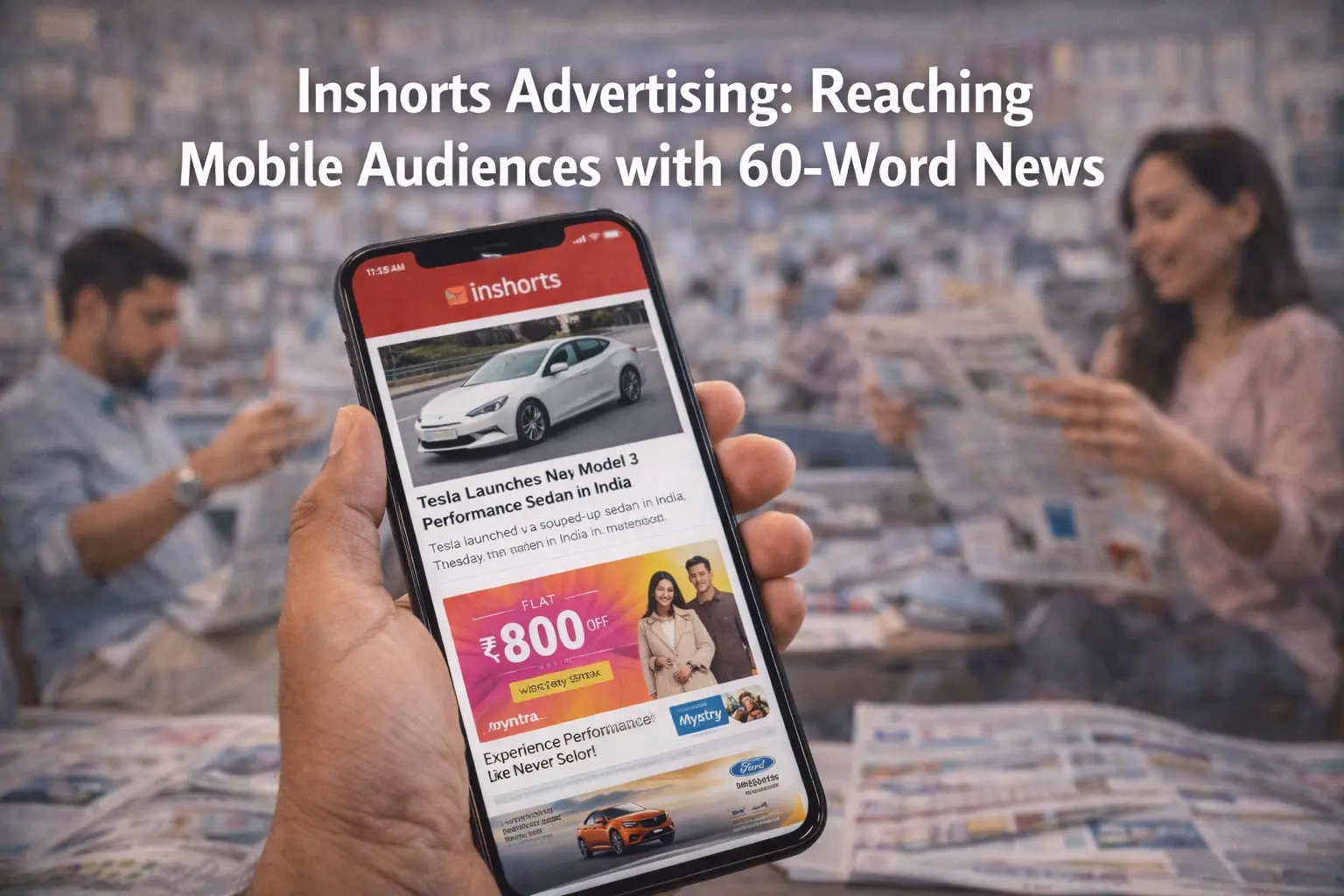
Inshorts is a mobile news app founded in 2013 that summarises headlines in 60 words . It has become one of India’s most popular news apps, with “more than 10 million app users” and over 10 million daily active users. This massive reach makes it a new media platform for brands. Inshorts’ advertising model integrates sponsored content directly into the newsfeed, respecting user experience while giving brands “excellent visibility”. Unlike newspaper ads or hoardings, Inshorts ads appear natively with the news, capturing attention in a less intrusive way. Inshorts ads are essentially native, display, and video ads within the app, designed to match the look and feel of the 60-word news format.
Advertisers should note that Inshorts primarily targets a young, mobile-savvy audience. According to media reports, over 78% of Inshorts’ users are aged 18–35, and the app’s user base skews college students and professionals. This demographic profile makes Inshorts an ideal platform for brands aiming at millennials and Gen Z. Inshorts users are highly engaged: one report found readers consume an average of 80 news “shorts” per day. In short, advertising on Inshorts means reaching “a sizable audience…actively seeking information” SmartAds is a format that fits their lifestyle.
Compared to traditional newspaper advertising, Inshorts offers a dynamic, data-driven approach. Newspapers (Hindi or English) remain widely read, but they are static and geographically limited. Inshorts, by contrast, is a nationwide (and even global) digital news app, combining the broad category appeal of a newspaper with precise digital targeting. For example, many brands once used classified ads in newspapers to reach niche audiences; today, advertisers can use Inshorts’ in-app categories and geo-targeting to reach specific segments more efficiently. As a SmartAds marketing executive puts it, advertising on Inshorts “respects user experience” and delivers high brand visibility in a mobile-first world.
Understanding the Inshorts audience is key for marketers. Inshorts users are largely concentrated in urban India, especially in tech-forward metros (Mumbai, Delhi, Bengaluru, etc.), although the app is available nationwide. Many users engage with Inshorts daily: the company reports over 10 million daily active users across its apps. Third-party data suggests Inshorts has 12+ million monthly active users.
Most Inshorts readers are young and educated. Studies show roughly 80% of Inshorts users are aged 18–35, and a significant portion are professionals or students keen on quick updates. Inshorts also offers content in Hindi, capturing a broader market beyond English speakers. While not a Hindi newspaper itself, Inshorts competes with print and digital Hindi news by offering Hindi summaries and even vernacular expansion. This bilingual content strategy helps it tap into India’s growing smartphone adoption: today people spend over 3.5 hours daily on mobile apps, far more than time on news sites or newspapers.
User engagement on Inshorts is extremely high, which appeals to advertisers. On average, an Inshorts user reads dozens of short news items per session. The app uses a swipe interface (similar to Tinder) and algorithmic personalization, so readers spend minutes at a time scrolling. This translates to brand recall: one metric from SmartAds notes that embedding ads as 60-word native display ads feels “less disruptive”and yields higher attention. Geo-targeting on Inshorts further allows local businesses to reach audiences “in specific locations”. All these trends mean Inshorts advertising can be very precise: you can target tech enthusiasts in Mumbai or sports fans in Delhi, whereas traditional newspaper ads rely on edition-based geography.
Inshorts offers a variety of ad formats to suit different campaign goals. The simplest are in-feed ads, which look like normal news “shorts” but marked as sponsored. These native text ads are limited to 60 words (like all content) and often have an image or logo. Because they follow the 60-word style, they blend naturally into the feed. Next are display ads: these include rectangular banner ads or cards that appear between news items. Some brands use video ads or rich media: for example, Inshorts supports auto-play video ads within the app. There are also article partnership ads, where a brand’s content takes the place of a full news story with images and links. Overall, the platform lists “more than six ad formats”, including creative formats like 360-degree video or interactive polls (similar to in-app stories).
Choosing the right ad type depends on your campaign. For brand awareness, video and display ads often work best. For driving clicks or conversions, native text ads might be more effective due to the high engagement. Importantly, Inshorts positions all ads with clear branding so users aren’t deceived – ads always say “Sponsored”. This builds trust: as one analysis notes, users check Inshorts about 15 days a month on average, meaning your ad is likely to be seen repeatedly. Marketers should craft messages that fit the concise style: think of an Inshorts ad like a mini newspaper headline, with a bold claim in 60 words.
Over time, Inshorts has experimented with special ad placements. For instance, a brand could run a roadblock campaign (taking all slots for a short time) or a masthead takeover (the top banner on app launch). While Inshorts doesn’t sell classified ads as in print, you can target categories akin to newspaper classifieds (e.g. tech, sports, entertainment) by choosing relevant content tags. Inshorts also occasionally features ‘promoted card’ layouts or branded sections. Regardless of format, all ads on Inshorts are part of the digital ad ecosystem, meaning they are booked and served programmatically or through Inshorts’ ad team, rather than through print vendors.
Launching an Inshorts advertising campaign is usually done through digital channels or via media buyers. In practice, you work with an advertising agency like SmartAds or directly with Inshorts’ marketing team. The process is fairly straightforward: first, you define your campaign objectives (awareness, leads, app downloads, etc.). Next, you choose ad categories and target demographics. Inshorts allows geo-targeting (city-wise) and some interest-based targeting. You then compose your ad, keeping copy under 60 words (SmartAds recommends writing a crisp headline-style message). You decide on ad format (text, image, video) and set a schedule (dates or number of impressions).
Booking the ad is done through an online portal or platform. Agencies often have access to an ad booking platform or online ad booking portal where they can upload creative, select dates, and pay securely. According to guidelines, ads typically take a day or two to go live after booking. Payment is handled online with credit/debit or net banking, with secure gateways (secure online payment) to ensure safety. There is no long newspaper booking process with forms or cheques – it’s all digital. SmartAds’ platform, for example, lets you “book your Inshorts ad” in minutes, comparing rates and audience data with other options.
Inshorts’ booking flexibility is a big plus. Campaigns can be as short as a week or span months. Budget-wise, digital Inshorts campaigns are often more accessible than full-page newspaper advertisements. Early reports hint that even a modest daily spend can yield large reach: one source notes that Inshorts banner ads could cost around ?0.3 per impression (though actual rates vary by format and demand). In practice, SmartAds finds that Inshorts often offers competitive advertising rates compared to other digital media, especially for youth segments. Before booking, it’s wise to check ad rates and available inventory. Tools like SmartAds can provide an ad booking platform comparison to show the best rates for your target audience. In general, as a digital news app, Inshorts pricing tends to favor brand campaigns and may have minimum spends, but offers flexibility typical of online booking.
One of the strengths of Inshorts advertising is measurability. Because it’s digital, advertisers get detailed analytics on impressions, clicks, and engagement. Inshorts provides in-app dashboards or reports showing how many users saw and interacted with an ad. Brands track KPIs like click-through rate (CTR), time spent on ad, and even conversions (if a tracking link is used). According to smartads, this “data-driven approach” lets advertisers optimize their Inshorts ads in real time. In practice, a campaign might start broad and then retarget high-performing segments or geographies.
Compared to newspaper ads (where you only get general circulation numbers), Inshorts lets you see performance by device, city, and demographic slice. For example, you can discover that a display ad had a higher CTR among Delhi users than Mumbai users, and adjust your spending accordingly. Engagement on Inshorts can also be estimated: one SmartAds analysis showed users read about 80 news shorts per session, suggesting high ad viewability. If your campaign includes video, you can see “view completion” rates. If your goal is app installs, you’d track installs from the Inshorts ad click. Many marketers find Inshorts ROI encouraging because of this transparency: some campaigns have reported above-average conversion rates when compared to generic social media ads, likely due to the intent-focused news context.
As an example of ROI, imagine a local restaurant booking an Inshorts ad targeting foodies in Mumbai. By monitoring clicks on the ad, the restaurant owner sees how many reservations come from Inshorts traffic. If 100 people clicked the ad and 10 booked tables, the 10% conversion can be tied back to campaign spend. Because Inshorts ads often cost less per impression than a full-page print ad, the cost-per-lead may be very attractive. SmartAds clients often use Inshorts advertising as part of a multi-channel mix, tracking results across all channels to see Inshorts’ relative performance. In short, the data and metrics make ad rates worth paying attention to.
Real-world case studies illustrate Inshorts’ potential. Many top brands have leveraged the app’s reach. For instance, Inshorts’ first advertiser was Airtel in 2016. By 2018, Inshorts had signed over 100 major clients, including Netflix, Maruti Suzuki, MRF Tyres, and Audi. Today, Inshorts claims 500+ brand partnerships. These campaigns often aimed for youth engagement. For example, an Airtel ad promoted mobile data plans, matching Inshorts’ tech-savvy audience. An automotive client like Maruti might run display ads around evening news updates, catching commuters.
One standout campaign (though not publicized) involved a streaming service launching a new show. They ran native sponsored summaries tied to news about media and entertainment. Because Inshorts users are heavy app consumers, this ad saw high click rates to the streaming platform. Similarly, an edtech company used Inshorts to reach students: they placed ads in education and career news sections. These targeted placements delivered more sign-ups than a generic online ad, according to insiders.
These successes come from tailoring content to the platform. SmartAds notes that brands which write crisp, conversational copy and match Inshorts’ tone do best. For example, instead of formal ad copy, a food delivery app might use a witty one-liner like “Hungry? Cravings solved in 60 words??” with a relevant image. Engagement is higher when ads blend in with news language. Overall, case studies suggest that Inshorts can amplify campaigns, especially for products or services that resonate with urban millennials.
As an advertising agency, SmartAds emphasizes data and creativity for Inshorts campaigns. SmartAds experts point out that Inshorts’ innovative advertising model creates a win-win: users get quick news, and advertisers get high visibility. SmartAds offers an online portal where brands can book their ad on Inshorts easily. They help clients navigate the advertisement booking process, choosing the right ad formats and target groups. SmartAds also advises on composing ads: they might write the 60-word message or optimize images for maximum impact.
SmartAds believes Inshorts is especially valuable for raising brand awareness. Its team notes: “Inshorts provides concise news and native ads, engaging users while offering brands high visibility”. In other words, because ads feel like part of the content, users are more receptive. SmartAds’s clients in Mumbai, Delhi, and across India have used Inshorts ads (and SmartAds often compares performance with other leading mediums, including Hindi newspaper classifieds and online platforms). The agency also highlights case studies on its site, showing how Inshorts ads contributed to increases in website visits, app downloads, or foot traffic.
In short, SmartAds positions itself as an advertising agency specialized in both digital and traditional media. For Inshorts, SmartAds will say: “Book your ad through us and reach India’s mobile audience instantly.” They underscore that booking is fully online, with secure payment and customizable ad campaigns. By leveraging SmartAds’s experience, brands can avoid common pitfalls like mismatched targeting or underutilizing Inshorts’ inventory.
Looking ahead, Inshorts continues to evolve its advertising offerings. Industry trends suggest a few directions: first, video and influencer content. Inshorts is increasingly featuring short videos (“Inshorts Shorts”) and user-generated news. Ads in these new formats are emerging – for example, a brand might sponsor a 15-second news clip. Second, hyperlocal targeting may grow: while Inshorts already allows city-level ads, expect more precise options (e.g. zip-code targeting, similar to how newspapers segment editions).
Another trend is performance marketing on Inshorts. As the app’s analytics improve, more advertisers will tie in apps and e-commerce; for instance, clicking an Inshorts ad could directly track a sale on an online store. This will attract ROI-focused marketers who previously preferred Google or Facebook for conversions. Additionally, with the rise of regional apps, Inshorts may expand beyond Hindi and English, enabling ads in Bengali, Tamil, etc., tapping into India’s large regional language market.
Importantly, privacy and regulations will shape Inshorts ads. As a news app, Inshorts avoids many of the privacy issues of social media, but it will still need to handle data carefully under Indian law. Advertisers should watch for changes in content guidelines (for instance, Inshorts recently navigated new news regulations). Overall, however, the trajectory is clear: mobile news consumption is growing, and Inshorts is well-positioned. For marketers, keeping up with these trends means regularly reviewing how Inshorts’ audience is changing and which ad formats engage them the most.
By leveraging Inshorts advertising with a data-driven strategy, brands can tap into India’s mobile-savvy audience and amplify their reach beyond conventional media. SmartAds can help you navigate this platform, ensuring your campaign uses the right ad type, message, and targeting for success. With mobile news consumption rising, Inshorts is poised to be a powerful channel in any marketer’s advertising portfolio.


