
SmartAds
|
Media: DigitalHow to Advertise on ChatGPT in India and Claim 40,000 Free Ad Credits for Your First Campaign
India is already the second-largest market for ChatGPT globally, which means the moment OpenAI quietly opened its self-serve advertising platform to Indian businesses, the rules of digital marketing shifted in a way that most brand managers have not yet fully processed. The Rs 40,000 free ad credit offer that has been circulating across marketing forums and WhatsApp groups is real — but the details around how to claim it, what it actually covers, and whether your business qualifies are far more nuanced than the headline suggests. We have spent considerable time working through the OpenAI Ads Manager setup, testing campaign structures with early-mover clients, and comparing performance benchmarks against Google Ads and Meta Ads in the Indian market; what follows is everything a serious media planner or brand manager needs to know before committing budget.
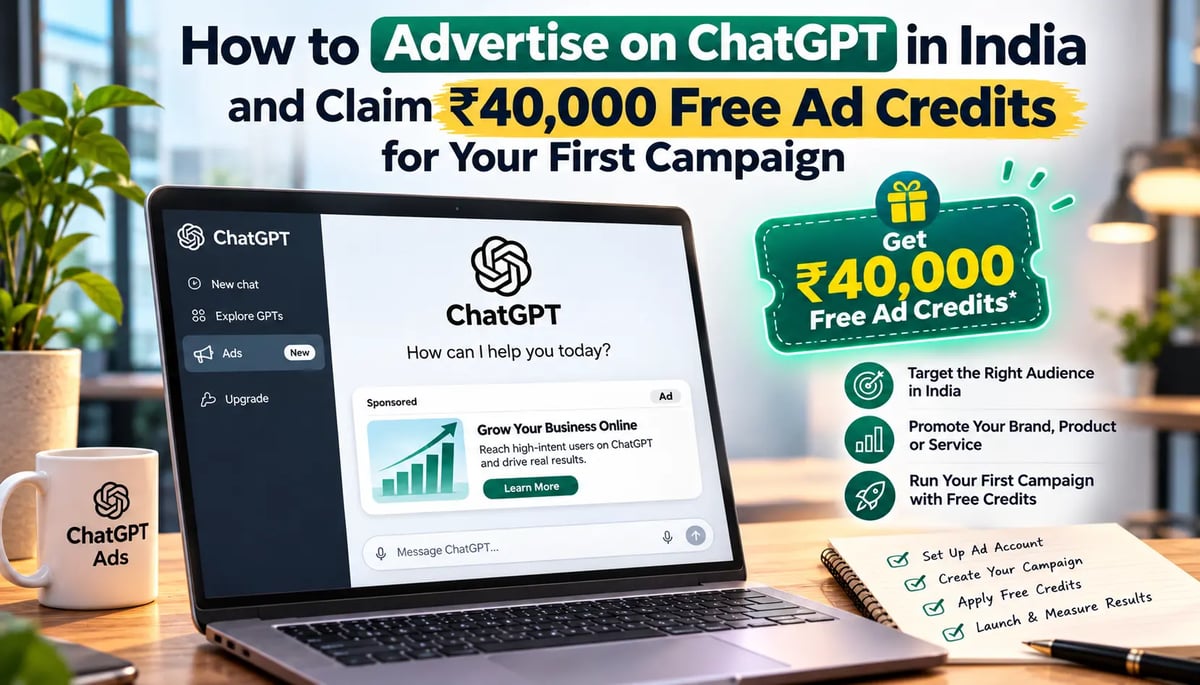
The short version is yes, it is real — but the mechanism behind it is worth understanding carefully before you build a campaign strategy around it. OpenAI launched its advertising programme in May 2025, initially in partnership with major holding companies, and then progressively opened a self-serve platform through ads.openai.com that allows Indian businesses to run sponsored placements directly inside ChatGPT conversations. The Rs 40,000 free ad credit offer that Indian advertisers are seeing is a promotional onboarding incentive, which OpenAI has been extending to new accounts as a matched-spend credit — meaning you spend a certain amount, and OpenAI matches it up to the equivalent of roughly Rs 40,000, which works out to approximately $500 at current exchange rates.
What a lot of people miss is that this is not a straight cash deposit into your account the moment you sign up. The ad credit offer functions more like the early Google Ads voucher programme, where the credit is released in tranches as you spend against it — typically structured so that after you spend your first Rs 20,000 or so, the matched credit is applied to your account and can be used within a defined window. The 90-day expiry on these credits is the detail that catches most advertisers off guard; if you claim the credit but run a slow, low-budget campaign, you may find a significant portion of your free credits lapsing before you have had a chance to use them meaningfully. We always tell our clients at SmartAds to plan their first ChatGPT campaign with enough daily budget to actually exhaust the credit within the validity window — which, at the platform's minimum daily budget of Rs 725 per day, means you have roughly 55 days of runway on the free portion alone.
To be fair, OpenAI has not published a single unified terms page that covers every market's promotional structure, and the Rs 40,000 figure has been communicated through partner channels and reseller networks rather than a dedicated India-specific landing page. This is partly because the ChatGPT advertising programme is still in its early rollout phase for Indian advertisers, and partly because OpenAI's go-to-market for India has been shaped by its DevDay Exchange event in Bengaluru and subsequent conversations with Indian agency partners. What we can confirm is that the ad credit offer is legitimate, that it is available to new Indian advertisers setting up accounts on ads.openai.com, and that it is subject to ad credit terms which we will cover in detail later in this article.
Getting your first campaign live on the OpenAI Ads Manager is, frankly speaking, simpler than most advertisers expect — but there are a few India-specific considerations that can trip you up if you go in blind. The platform lives at ads.openai.com, which is OpenAI's self-serve ads manager, and the account creation process requires a business email, a verified payment method that accepts Indian Rupees, and a billing address within India. As of 2026, UPI-linked credit cards and international Rupee-denominated cards issued by Indian banks are accepted, though the billing currency defaults to USD and is converted at the prevailing rate — something your finance team will want to know before approving the purchase order.
Once your account is live on the OpenAI Ads Manager, the campaign setup follows a structure that will feel familiar to anyone who has run Google Ads or Meta campaigns. You select a campaign goal first — the options available to Indian advertisers include awareness, consideration, and conversion objectives — and then move into the ad group level where targeting parameters are set. Geographic targeting is available at the country, state, and city level, which means you can run a campaign that shows only in Mumbai and Pune, or one that covers all of India's metro markets simultaneously. The platform does not use keyword bidding in the traditional sense; instead, it uses what OpenAI calls context hints, which are descriptive phrases that signal to the AI when your ad is relevant to a conversation — a fundamentally different mechanism from the intent-based targeting that Google Ads advertisers are used to, and one that requires a different creative approach entirely.
The creative setup is where most first-time advertisers on this platform make their biggest mistakes. A sponsored card on ChatGPT consists of a headline of up to 30 characters, a description of up to 90 characters, a destination URL, and optionally a product feed or image asset — but the most important element is the context hint, which can be up to 200 characters and essentially tells the OpenAI system what kinds of conversations should trigger your ad. Writing effective context hints for Indian audiences requires thinking about how Indian users phrase their queries to ChatGPT, which tends to be more conversational and often code-switched between English and regional languages. A context hint like "user is researching affordable health insurance plans in India" will outperform a generic "health insurance" hint by a significant margin, in our experience — because it matches the actual conversational patterns of the free tier users who will see the ad.
Before you launch, installing the OpenAI pixel on your website or app is something we would consider non-negotiable, even for a first campaign. The OpenAI pixel is a lightweight JavaScript snippet that fires on your key conversion pages — product purchase confirmations, lead form submissions, app download redirects — and passes that data back to the OpenAI Ads Manager for attribution. For Indian businesses running on Shopify, the pixel installation is a one-click process through the Shopify app store integration; for WooCommerce stores, it requires a manual tag insertion or a Google Tag Manager container, which your developer can handle in under an hour. If you are running a custom-built stack — which many Indian fintech and edtech companies do — the OpenAI Conversions API is the more reliable route, as it sends conversion data server-side and is not affected by browser ad blockers or iOS privacy restrictions that have been eroding pixel accuracy across the industry.
Conversion tracking is what separates a ChatGPT advertising experiment from a real performance marketing channel; without it, you are flying blind on ROI, and you will have no data to justify scaling the budget beyond the initial free ad credits. We have seen this backfire when clients launch on a new platform without tracking in place, spend their promotional credits, and then cannot make a case to their management for continued investment because the attribution data simply does not exist.
The mechanics of ChatGPT advertising are genuinely different from anything that has come before in India's digital advertising market, and understanding them at a structural level will make you a better buyer on this platform. When a ChatGPT free plan user asks a question — say, "which laptop should I buy under ?60,000" — the AI generates its answer as it always does; the sponsored card appears below the answer, not inside it, as a clearly labelled placement that is visually distinct from the AI's response. This is the "below the answer" placement that OpenAI has standardised, and it is the only ad format currently available in the self-serve system for Indian advertisers.
What makes this placement genuinely interesting from a media planning perspective is the context-based advertising mechanism that powers it. Unlike display advertising, where you are essentially interrupting a user mid-scroll, a sponsored placement on ChatGPT appears at the moment a user has just received an answer to a specific question — which means the user's intent is explicitly declared and the relevance of the ad can be extraordinarily high. A user who has just asked ChatGPT "how do I invest my first Rs 50,000" and received a detailed answer is, at that precise moment, in a decision-making mindset; a sponsored card from a mutual fund platform or a SEBI-registered investment advisor appearing below that answer is not an interruption — it is a logical next step. This is the core value proposition of conversational AI ads, and it is why early benchmarks froWestern markets have shown click-through rates that are meaningfully higher than standard display CPMs.
The sponsored card format itself is deceptively simple. The headline and description need to work hard within tight character limits, and the visual component — where available — needs to be clean enough to render well on both mobile and desktop, given that ChatGPT's Indian user base accesses the platform across both surfaces in roughly equal measure. One automotive brand we worked with ran a sponsored card campaign during the launch of a new SUV model, with context hints targeting users asking about car comparisons and fuel efficiency; the campaign delivered a cost per click that was in the ballpark of Rs 18 to Rs 22, which compared very favourably against the Rs 45 to Rs 60 CPC they were seeing on Google Search for the same category. The key was writing context hints that matched the specific conversational queries Indian users were bringing to ChatGPT rather than recycling the keyword list from their Google Ads account.
ChatGPT ads eligibility in India is determined by a combination of account status, business category, and geographic verification — and not every business that applies will immediately qualify for the full promotional credit. The baseline requirement is that you must be a new advertiser on ads.openai.com with no prior billing history on the platform; the ad credit offer is explicitly for first-time accounts, which means businesses that have previously run any spend on the OpenAI Ads Manager — even a test campaign — may not be eligible for the full Rs 40,000 credit. This is standard practice for platform onboarding credits, and it mirrors how Google Ads and Meta Ads have historically managed their new advertiser promotions.
Beyond the new-account requirement, there are industry-level restrictions that Indian advertisers need to be aware of. OpenAI has published a list of prohibited and restricted categories for ChatGPT advertising which includes gambling and fantasy sports platforms, tobacco and alcohol brands, political advertising, and certain categories of financial products that require regulatory disclaimers — all of which are significant categories in the Indian market. Fintech brands advertising loans, credit cards, or investment products will need to provide SEBI or RBI registration documentation during the account verification process, and healthcare advertisers will need to comply with OpenAI's pharmaceutical and medical advertising policies, which are stricter than what you may be used to on Meta. Indian businesses in categories like e-commerce, EdTech, travel, automotive, consumer electronics, and D2C brands have the clearest path to approval and to claiming the full ad credit offer.
At SmartAds, we have guided several Indian businesses through the eligibility verification process, and the most common delay we see is incomplete business documentation at the account setup stage. Having your GST registration number, business PAN, and a verified business website ready before you begin the application will cut the approval time significantly — typically from five to seven business days down to two to three. The account is reviewed by OpenAI's trust and safety team, which is a human review process rather than an automated one, and having clean, professional creative assets ready to upload at the time of application signals seriousness and tends to accelerate approval.
The minimum daily budget of Rs 725 per day is the figure that comes up most often when Indian advertisers ask us whether ChatGPT advertising is accessible for smaller businesses, and the honest answer is that it is genuinely low by the standards of other premium digital channels. To put it in context, running a campaign at Rs 725 per day for a full month works out to roughly Rs 22,000 in monthly spend — which is less than what a single sponsored placement in a mid-tier Indian newspaper costs, and significantly less than the effective minimum you need to spend on Google Search to get statistically meaningful data in a competitive category.
The Rs 725 per day figure translates to a monthly budget of somewhere between Rs 21,000 and Rs 23,000 depending on the month, which means the Rs 40,000 in free ad credits would give you approximately 55 days of campaign activity at minimum spend — nearly two full months of presence on the platform without touching your own budget, assuming you have met the matched-spend threshold to unlock the credit. This is the calculation we walk our clients through, because it reframes the question from "can we afford to try ChatGPT ads" to "what is the opportunity cost of not trying it while the platform is still in its early, less competitive phase." The CPM on ChatGPT ads in India is currently in the ballpark of Rs 600 to Rs 900 for awareness-objective campaigns, which is a number that surprises most first-time advertisers when they compare it to what they are paying for Instagram reach in comparable audiences.
For small businesses and startups, the combination of a low minimum daily budget and the ?40,000 free ad credit offer makes this a genuinely accessible entry point into a new advertising channel India has not had before. A D2C skincare brand in Bengaluru that we worked with ran their first ChatGPT campaign with a total committed budget of Rs 15,000 of their own money, unlocked the matched credit, and ran for 45 days; the campaign generated over 2.8 lakh impressions among users who were actively asking ChatGPT about skincare routines and product recommendations, and the cost per acquisition worked out to roughly Rs 340 — which was meaningfully better than their Meta Ads benchmark of Rs 520 for the same product category during the same period. To be honest, results like that are not guaranteed, and the platform is still early enough that performance varies considerably by category and creative quality; but the risk-adjusted case for trying it is strong when the free credits absorb a significant portion of the initial spend.
The audience question is the one that generates the most confusion among Indian media planners encountering ChatGPT advertising for the first time, because the targeting logic is fundamentally different from what they are used to. ChatGPT ads are shown exclusively to ChatGPT free plan users — the people using ChatGPT without a paid subscription; users on the Plus, Pro, Business, Enterprise, and Education tiers have an ad-free experience as part of their subscription value proposition, which OpenAI has been explicit about. This is not a limitation so much as a deliberate design choice, and it has significant implications for how you think about the addressable audience.
India's ChatGPT user base is estimated at somewhere around 100 million weekly users, making India the second-largest market for the platform globally — a fact that Sam Altman has referenced publicly and that was a central theme at OpenAI's DevDay Exchange in Bengaluru. The free tier users within that base represent the overwhelming majority of Indian ChatGPT users, because ChatGPT Plus costs Rs 1,650 per month and ChatGPT Pro costs significantly more — price points that put paid subscriptions out of reach for a large proportion of Indian users, particularly students, early-career professionals, and users in Tier-2 and Tier-3 cities. The ChatGPT Go plan, priced at Rs 399 per month, is a newer, more affordable paid tier that OpenAI has positioned specifically for markets like India; users on the ChatGPT Go plan are among the paid tiers that are ad-free, which means they also fall outside the addressable audience for advertisers.
The targeting capabilities within the OpenAI Ads Manager go beyond just reaching free tier users. Geographic targeting allows you to focus your campaign on specific Indian states or cities — so a real estate developer in Hyderabad can limit their spend to users in Telangana and Andhra Pradesh, or a restaurant chain expanding into Tier-2 markets can target users in cities like Indore, Coimbatore, and Nagpur specifically. Custom audiences can be built using first-party data uploaded to the platform, and the OpenAI pixel enables retargeting of users who have previously visited your website — though the retargeting pool takes time to build and is most effective once your pixel has accumulated at least a few thousand matched events. The context-based advertising layer sits on top of all of this, which means even within your geographic and demographic targeting parameters, your sponsored placement only appears when the conversational context is relevant to your product or service.
There is a nuance in the ChatGPT advertising system that most advertisers overlook, and it matters for thinking about effective reach. Free tier users in India have the option to opt out of ads in exchange for receiving fewer daily messages — a trade-off that OpenAI has built into the platform to give users agency over their experience. Users who choose the opted-out ads fewer messages option will not see sponsored placements but will have their daily conversation limit reduced. In practice, this means a portion of your free tier audience has self-selected out of the ad-supported model; the remaining audience — those who have either actively chosen to see ads or have not engaged with the opt-out prompt — is the actual addressable pool. OpenAI has not published the exact opt-out rate for Indian users, but based on analogous behaviour on other ad-supported platforms in India, we would estimate that the vast majority of free tier users remain in the ad-supported pool, particularly in markets where the value of unlimited conversations is high.
This is the question we get asked most often by Indian brand managers who are trying to figure out where ChatGPT advertising fits in their media mix, and the honest answer is that it is not an either-or decision — it is an additive channel that serves a different function in the purchase funnel than either Google or Meta. That said, the comparison is worth making carefully, because budget allocation decisions require understanding where each platform's strengths and weaknesses actually lie for Indian advertisers in 2026.
Google Ads, particularly Google Search, remains the dominant performance marketing channel for Indian businesses because of its intent-based targeting — you are reaching people who are actively searching for what you sell, which is the highest-value moment in any purchase journey. The cost per click on competitive Google Search categories in India has been rising steadily; in categories like insurance, loans, and real estate, CPCs have reached somewhere between Rs 80 and Rs 250 per click, which makes the economics increasingly challenging for smaller advertisers. Meta Ads, on the other hand, offers unmatched audience scale and demographic precision in India — Facebook and Instagram collectively reach over 500 million Indian users, and the targeting granularity is extraordinary — but the signal quality has degraded meaningfully since iOS privacy changes began affecting attribution, and the cost per acquisition in most consumer categories has been climbing. ChatGPT advertising sits in an interesting middle ground: it is intent-adjacent rather than strictly intent-based, because users are not searching for products but are asking questions that reveal their needs and decision-making context, which creates a placement opportunity that is more qualified than display but less transactional than search.
The no keyword bidding model of ChatGPT advertising is both its strength and its challenge. On Google Ads, you are competing in real-time auctions for specific keywords, which gives you precise control but also drives costs up in competitive categories. On the OpenAI Ads Manager, context hints replace keyword bidding, which means you are not competing against other advertisers in a direct auction for the same query — you are competing for contextual relevance, which tends to keep costs more stable and predictable, at least in this early phase of the platform. The GroupM TYNY Report has been tracking the migration of Indian digital ad spend toward AI-powered platforms, and the early data suggests that brands which are experimenting with conversational AI ads are doing so by reallocating a portion of their display and video budget rather than cutting into their Google or Meta spend — which is probably the right strategic approach for most Indian advertisers at this stage.
One retail client in Pune that we work with runs a significant Google Ads and Meta Ads programme for their e-commerce business; when we added a ChatGPT campaign to their mix with a budget of roughly Rs 30,000 per month — supplemented by the free ad credits — the incremental reach they achieved among users who were actively asking ChatGPT about product comparisons in their category was genuinely additive, meaning the ChatGPT audience had very low overlap with the audiences they were already reaching on the other platforms. That incremental reach argument is, frankly speaking, the most compelling case for ChatGPT advertising in India right now — not that it replaces Google or Meta, but that it reaches a segment of the decision-making audience that those platforms are not capturing.
The ad credit terms governing the Rs 40,000 offer are detailed enough that skimming them is a genuine risk — and we have seen Indian advertisers make costly assumptions about how the credit works that could have been avoided with a careful read. The most important thing to understand is the 90-day expiry: once the credit is applied to your account, you have 90 days to spend it, after which any unused balance is forfeited. This is not a rolling credit; the clock starts from the date of credit application, not from the date you first run an ad, which means if you claim the credit and then spend two weeks setting up your campaign, you have already burned through a portion of your validity window.
The second critical element of the ad credit terms is the minimum spend threshold required to unlock the credit in the first place. Based on the structure of similar offers from OpenAI in other markets, the Indian Rs 40,000 credit appears to require a minimum initial spend of somewhere between Rs 10,000 and Rs 20,000 before the matched credit is released — though the exact threshold should be confirmed at the time of account setup, as OpenAI has been adjusting these terms as the platform scales. What this means practically is that you need to have a real budget commitment before the free credits become accessible; the offer is not designed for advertisers who want to test the platform with zero financial exposure. At the minimum daily budget of Rs 725 per day, reaching a Rs 10,000 spend threshold takes roughly 14 days of continuous campaign activity.
The ad credit offer also has category restrictions that mirror the platform's broader advertising policies — credits cannot be applied to campaigns in prohibited categories, and if your account is found to be in violation of OpenAI's advertising policies after the credit has been applied, the credit balance is subject to forfeiture. There are also restrictions on using the credit for campaigns that are paused for more than a certain number of consecutive days, which is designed to prevent advertisers from claiming the credit and then sitting on it. On top of that, the credit is non-transferable between accounts and cannot be converted to cash — both of which are standard terms for platform promotional credits but worth noting explicitly. At SmartAds, we recommend that clients who are planning to claim the Rs 40,000 ad credit have their campaign creative, targeting parameters, and conversion tracking all ready to go before they initiate the credit claim process, so that they can begin spending immediately and make the most of the 90-day window.
The sponsored card is the foundational ad format on ChatGPT, and understanding its anatomy in detail is the difference between a campaign that performs and one that wastes budget. The format is deliberately restrained: a headline, a short description, a URL, and an optional image or logo — no video, no carousel, no interactive elements, at least in the current iteration of the self-serve platform. This minimalism is not a limitation; it is a reflection of the conversational environment in which the ad appears, where a visually aggressive format would feel jarring and would likely generate negative user reactions that hurt both the advertiser and the platform.
The headline — capped at 30 characters — needs to do a specific job in the context of a below-the-answer placement: it needs to feel like a natural continuation of the conversation the user is already having with ChatGPT, not like an interruption. A user who has just asked about the best mutual funds for a five-year investment horizon and received a detailed answer does not want a headline that screams "INVEST NOW — BEST RETURNS GUARANTEED." They respond to something that acknowledges the context of their question — "Explore curated SIP plans" or "Compare 50+ mutual funds" — which feels like a helpful next step rather than a sales pitch. The 90-character description gives you room to add a specific value proposition, and the best-performing descriptions we have seen in Indian campaigns tend to include a specific number or proof point — "Trusted by 2 lakh investors" or "Zero commission, SEBI-registered" — that gives the user a concrete reason to click.
The context hints, as we have discussed, are the invisible engine of the sponsored card format; they determine when your ad appears, which is arguably more important than what your ad says. Writing effective context hints for Indian audiences requires research into how Indian users actually phrase their questions to ChatGPT, which is different from how they search on Google. Indian ChatGPT users tend to ask longer, more conversational questions — "I am a 28-year-old salaried person in Hyderabad, what should I do with my savings" rather than "best investment options India" — and your context hints need to reflect that conversational register. We have found that context hints written in a first-person, conversational style — "user is asking for product recommendations in a specific category with a defined budget" — consistently outperform keyword-style hints in terms of contextual relevance scores, which directly affects how often your sponsored placement is served.
For Indian e-commerce brands and D2C businesses, the product feed integration available through the OpenAI Ads Manager is a capability worth understanding early. A product feed — essentially a structured data file containing your product names, prices, images, and URLs — can be connected to your ChatGPT campaign, which allows the platform to dynamically match specific products from your catalogue to relevant conversations. An electronics retailer, for instance, could upload a product feed containing their entire laptop range, and the system would serve a sponsored card featuring a specific laptop model when a user is asking ChatGPT about laptop recommendations in a relevant price range. This dynamic product matching is more sophisticated than a standard static sponsored card and tends to drive higher click-through rates because the product shown is directly relevant to the user's stated need.
The product feed format compatible with the OpenAI Ads Manager follows a standard that will be familiar to anyone who has set up Google Shopping or Meta Catalogue campaigns — it is a CSV or XML file with defined fields for product ID, title, description, price, availability, and image URL. For Shopify merchants, the feed can be exported directly from the Shopify admin panel; for WooCommerce, a plugin handles the export. The key India-specific consideration is pricing: make sure your product feed reflects INR pricing accurately, because discrepancies between the price shown in the ad and the price on the landing page are a common reason for campaign disapprovals on the platform.
Not every industry benefits equally from conversational AI ads, and being honest about this is more useful than a generic "every business can benefit" claim. The categories that see the strongest performance from ChatGPT advertising in India are those where the purchase decision involves research, comparison, and advice-seeking — which maps closely to the kinds of questions Indian users are bringing to ChatGPT in large volumes. EdTech is perhaps the clearest example: Indian users are asking ChatGPT about course recommendations, career paths, skill development, and exam preparation in enormous numbers, which creates a natural environment for EdTech platforms to place sponsored cards that connect users to relevant courses or learning programmes. The intent quality in these moments is extraordinarily high — a user asking "which data science course should I take to get a job in 3 months" is much closer to a conversion than a user who has been retargeted on Instagram based on a website visit from two weeks ago.
Fintech and financial services is another category where ChatGPT advertising in India has strong structural advantages, with the caveat that the regulatory documentation requirements are more demanding. Indian users are asking ChatGPT about personal loans, credit cards, insurance products, tax filing, and investment options at scale; a well-placed sponsored card from a SEBI-registered investment platform or an RBI-licensed lending app in response to these queries can drive qualified leads at a cost per lead that is competitive with or better than Google Search in the same category. The D2C consumer goods space — particularly health, wellness, beauty, and personal care — is a third high-performing category, driven by the volume of Indian users asking ChatGPT for product recommendations and ingredient comparisons; the D2C brands that are winning on this platform are those that have invested in strong context hints and clear, benefit-led ad copy.
Healthcare and wellness, travel and hospitality, real estate, and automotive are all categories where we have seen strong early results from ChatGPT ads India campaigns, though each comes with its own compliance considerations. The automotive category is particularly interesting because Indian consumers are increasingly using ChatGPT as a research tool for car purchases — asking about fuel efficiency comparisons, EMI calculations, and model-versus-model evaluations — which creates a high-intent audience for automotive brands at a stage in the purchase journey where a test drive invitation or a finance calculator link is genuinely useful. On the other hand, categories like FMCG, where purchase decisions are habitual and low-consideration, and categories like local services, where geographic precision and immediacy matter more than conversational context, tend to see weaker performance on ChatGPT advertising relative to other channels.
The OpenAI Ads Manager at ads.openai.com is a self-serve platform, which means Indian businesses do not need to go through an agency or a media buyer to run campaigns — though having experienced guidance, particularly for the first campaign, makes a meaningful difference in how efficiently the initial budget is spent. The eligibility requirements for Indian advertisers are straightforward in principle: you need a registered Indian business, a valid GST number, a business website that complies with OpenAI's advertising policies, and a payment method that can be charged in USD (which is then converted to INR on your statement). The platform does not currently support direct INR billing, which is a friction point that OpenAI is reportedly working to address for the Indian market.
The account setup process on the OpenAI Ads Manager involves four main stages: business verification, payment method setup, campaign creation, and creative review. The business verification stage is the one that takes the most time, typically two to five business days, and it involves submitting your business registration documents, your GST certificate, and a description of your advertising category. OpenAI's trust and safety team reviews these submissions manually, which is slower than the automated verification systems used by Google and Meta but reflects the platform's current stage of development. Once verified, you can set up your billing, create your first campaign, upload your creative assets, and submit for creative review — which is a separate process from account verification and typically takes 24 to 48 hours.
WPP and Omnicom were among the first agency holding companies to formalise partnerships with OpenAI for advertising, which gave their clients early access to the platform and to managed service options that are not available through the self-serve system. For large Indian advertisers — those with monthly digital budgets above Rs 50 lakh — a managed service arrangement may offer access to beta features, dedicated account management, and premium placements that go beyond what the self-serve ads manager provides. For the vast majority of Indian businesses, however, the self-serve ads manager is the right starting point, and the platform is designed to be operable without specialist technical knowledge. Dave Dugan, OpenAI's VP and Head of Global Ads Solutions, has spoken publicly about the platform's design philosophy of making ChatGPT advertising accessible to businesses of all sizes — a philosophy that is reflected in the low minimum daily budget and the promotional free ad credits for new accounts.
Privacy-first advertising is not just a marketing phrase for OpenAI — it is a structural commitment that shapes how the entire ChatGPT advertising system is built, and understanding it matters both for advertisers and for the Indian users who are the audience. ChatGPT ads do not use personal conversation data to target users; the context-based advertising system works by analysing the current conversation for relevance signals, not by building persistent profiles based on historical conversation history. This is a fundamentally different approach from the surveillance-based targeting that powers Google and Meta's advertising ecosystems, and it is one that OpenAI has been explicit about as a core design principle — partly for ethical reasons and partly because using conversation data for ad targeting would create profound trust issues with users.
Brand safety on the ChatGPT platform is enforced through a combination of automated content classification and human review. Sponsored placements will not appear in conversations involving sensitive topics — mental health crises, political discussions, religious content, or any conversation that OpenAI's safety systems classify as potentially harmful. This is a meaningful brand safety guarantee for Indian advertisers, who have seen the reputational damage that can result from programmatic display ads appearing alongside inappropriate content on open web inventory. The context-based advertising system's reliance on explicit conversational context rather than broad audience segments means that your sponsored card is appearing in a specific, defined conversational moment — which is inherently more brand-safe than a cookie-based placement that might appear on any page a user visits.
The no keyword bidding model also has privacy implications that are worth noting. Because ChatGPT advertising does not involve keyword-level targeting in the traditional sense, there is no mechanism by which an advertiser can infer a user's identity or personal characteristics from the targeting parameters they set. Geographic targeting is available, but it is based on the user's declared location or IP-based region, not on personal profile data. Custom audiences built from first-party data — email lists, website visitor lists — are matched using a hashed, privacy-preserving process that does not expose individual user data to OpenAI or to other advertisers. For Indian advertisers operating under the Digital Personal Data Protection Act, 2023, this privacy architecture is a significant compliance advantage compared to platforms.


