SmartAds
|
Media: OutdoorAdvertising on Bangalore Cantonment Railway Station Road: Trends, Data & Opportunities
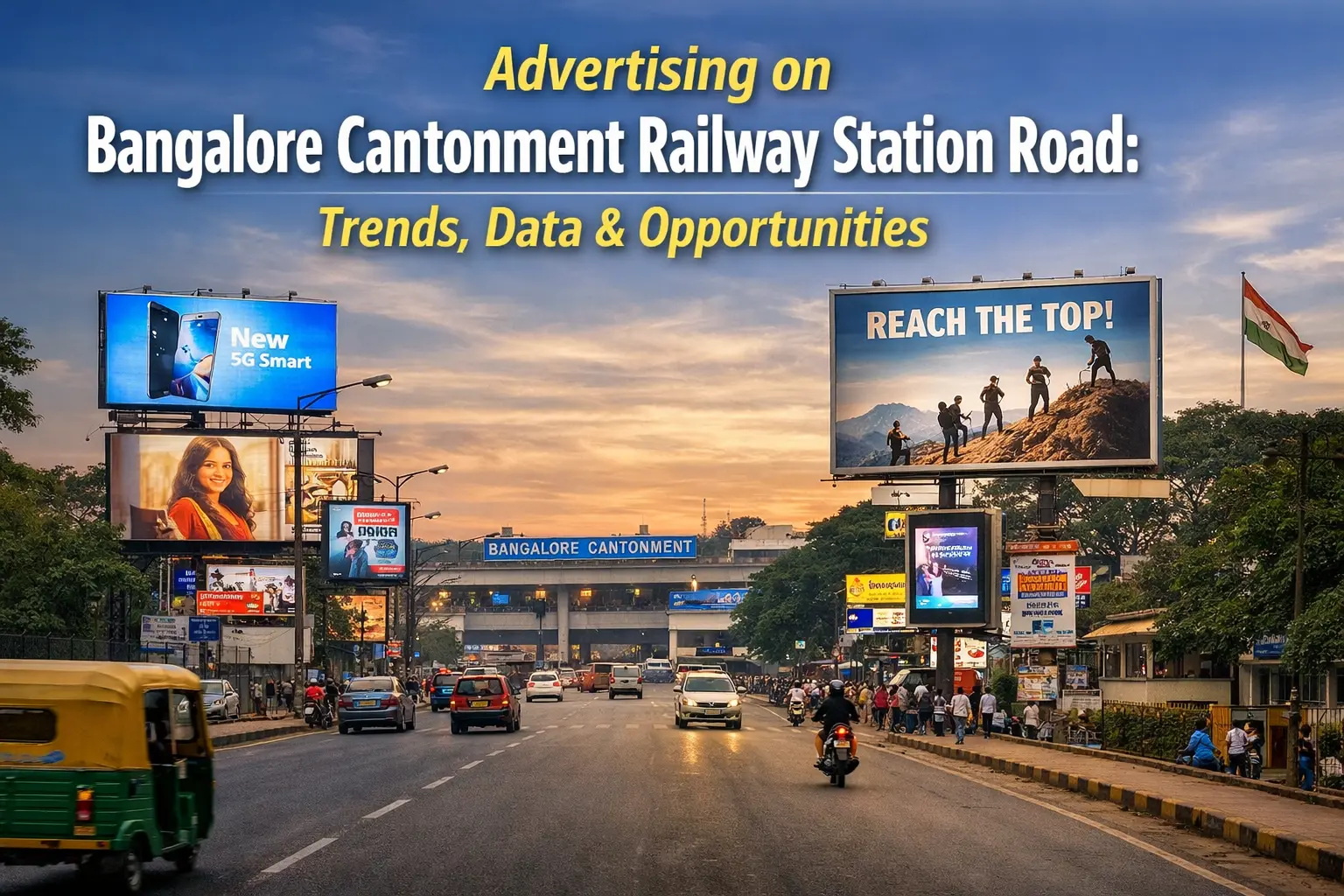
Bangalore Cantonment Railway Station Road is a bustling corridor in the city with heavy commuter traffic. In fact, the station used to handle over 20,000 passengers dailyand a prime billboard at Cantonment can reach ~1 million people (3.7million impressions). For marketers and media planners, this means enormous visibility – commuters waiting for trains are a captive audience. In this data-driven guide, we explore how to leverage Cantonment Road for advertising: from outdoor hoardings and digital displays to newspaper classified ads. We cover booking processes, ad formats, costs, and key case studies – all to help brands and agencies plan effective Cantonment Station Road campaigns supported by real insights.
Outline
Bangalore Cantonment Railway Station Road enjoys massive foot traffic and a captive audience. The area sees over 20,000 daily commuters, many of whom wait on platforms or in the concourse. Industry sources note that railway station ads are “the easiest, fastest and most effective way to reach lakhs of consumers”SmartAds. Unlike people on the move, passengers waiting for trains have time to notice ads: they form an “unparalleled opportunity to reach a vast audience”. In Bangalore’s tech-driven economy, commuters include professionals, students and families, covering broad demographics. Research also finds that stations have very high dwell time, so ads deliver high engagement and impact. In short, Cantonment’s crowd is large, diverse and relatively stationary – a marketer’s ideal audience.
This captive audience also means lower cost-per-impression (CPI) than many media. smartads analysts point out that station advertising costs are generally much lower per view, making Cantonment Road a cost-effective choice. Commuters cannot easily “skip” these ads like digital banners, so the message sticks. Outdoor billboards in busy areas typically command large viewership, and at Cantonment Road they run 24/7 for continuous exposure. In fact, experts report rail campaigns can reach up to 100,000 people per unit when using non-traditional formats like branded vehicles– underscoring the scale possible here.
Advertisers have many formats to choose from around Cantonment Station. The most common are outdoor hoardings and billboards on or near the station. Large static billboards or flex hoardings can be placed along Cantonment Road or on station walls, catching passengers and passersby. Digital screens and LED panels inside or outside the station offer dynamic video ads. Media planners note that station branding – from platform wraps to turnstile displays – can achieve “complete station domination” of visibility. These formats leverage the incredibly high dwell time of commuters to deliver outstanding ROI.
In the broader Bangalore market, other high-traffic OOH sites include junctions and major roadways. Hoardings along busy roads like MG Road or Commercial Street similarly “ensure your message reaches a large and diverse audience” SmartAds. Bus shelters, metro pillars, and transit shelter ads near Cantonment Station can also target local traffic. The key is 24/7 exposure – unlike limited-time TV ads, a hoarding on Cantonment Road displays your brand around the clock.
For example, mobile vehicles can act as moving hoardings. The image above shows a Tata Ace canter truck wrapped in a retail ad. Non-traditional ads like this can roam busy areas (including Cantonment Road) to reinforce your message. SmartAds notes that such Canter Activity advertising is “more organic, authentic, and relevant” to local audiences, often reaching ~100K people per campaign .
Booking an outdoor hoarding or billboard by Cantonment Road involves a few steps. Many advertisers work through agencies or OOH specialists who have the railway’s advertising contacts. Some online portals (like SmartAds) streamline this: for instance, SmartAds’ own platform tells users to “Login or Create Account, View All Media Details, and Create Customised Plan” to book any media. On such portals you can filter by location (choose Bangalore > Cantonment), select a billboard or LED unit, and then customize your run dates and creative. Official railway ad panels may require coordination with the South Western Railway’s advertising department, but agencies often handle that.
To secure a spot, decide on duration and design. Hoardings are typically booked in advance – weeks or months before campaign launch – because prime locations fill up quickly. Once you choose a site (e.g. a Cantonment Road flex board), submit artwork to spec and pay the fee. Agencies often assist with media planning and negotiation to get the best rates. According to industry insights, bulk or long-term bookings can earn discounts, so planners will “secure the lowest rates and prime slots” by negotiating on quantity and run-time. Payment is usually due upfront or in instalments before the ad goes live.
Besides OOH, print media remains influential. For the Cantonment area, major Bangalore newspapers (like The Times of India, Hindustan Times, or local weeklies) allow geographic targeting. A common strategy is to buy a display advertisement in the Bangalore edition of TOI or The Hindu, placing it near relevant stories or in sections read by commuters (e.g. city news or lifestyle). The Times of India’s ad portal highlights that display ads “reach readers across Times of India publications”, meaning your Cantonment Road message could appear in multiple sections. You can choose page (front page vs. inside) and size (quarter, half, full page) depending on budget and impact.
For smaller budgets, classified ads are very effective. Text classifieds (announcements in columns) are the “most popular and cost-effective format” of newspaper advertising. You would log in to the newspaper’s ad booking site (or use a national portal), select the city (Bangalore), and pick a category (e.g. public notices, business ads, personal announcements). Writing a short, targeted ad (for example, “New shop opening near Cantonment Station – sale on all items”) can alert local readers. These classified ads are charged by line or word, and the TOI site even shows a preview before booking.
In summary, print options include both display ads with images/logos (higher cost, higher impact) and classified text ads (cheaper, straightforward). Agencies often use SmartAds’ or similar services to book these quickly. For example, TOI’s portal lets you place a classified in minutes, with rates shown up front. Just be sure to mention “Cantonment” or “Station Road” in the copy so the ad lands in relevant local searches or interest areas.
Classified advertising lets you target specific audiences in print or online. If your business or event is tied to Cantonment Road, a classified is a great choice. First, identify the right category: jobs, real estate, services, etc., that matches your message. Then use an online portal (e.g. ads.timesofindia.com for TOI or relMyAd.com) to book a classified ad online. These portals allow you to choose Bangalore edition and enter your ad text. The interface highlights that classified texts are budget-friendly – the TOI site literally calls them “cost-effective”.
For example, a local shop might place a classifieds ad like “Grand Store Opening – Cantonment Station Rd – special sale this weekend. Visit us by Platform 1.” This concise text ad would cost far less than a display ad but still reach active readers. After booking, you get confirmation and can usually pay online securely. Many newspapers also publish these classifieds on their website, so your Cantonment Road ad might even appear in digital archives or searches.
Online classifieds (e.g. on Google or OLX) can complement print. Keywords like “Cantonment Station Road” can be included in online ads or directory listings to catch search traffic. Overall, classified ads (both print and online) are quick to launch and can be adjusted on the fly. They are especially useful for time-sensitive promotions (sales, events) tied to that neighborhood.
While Bangalore is largely English-speaking, many commuters read Hindi newspapers or media. If your target audience includes Hindi speakers near Cantonment Road, consider Hindi-language advertising. The city does have editions of national Hindi dailies (e.g. Hindustan, Dainik Jagran, Rajasthan Patrika) and a Hindi supplement of major papers. You can book ads in these just as in English papers – through their advertising portals or classified desks. For instance, a Hindi classified in Hindustan Bangalore or Dainik Bhaskar could alert local readers to your Cantonment Road message.
SmartAds and other agencies note that incorporating Hindi (for local names, slogans, or newspapers) can widen reach among certain demographics. However, precise readership data for Hindi editions in Bangalore is scarcer. A safe approach is to ask your media partner about Hindi insertions or to check if Delhi-based Hindi newspapers circulate locally. In practice, running bilingual campaigns (English + Hindi) in the vicinity of Cantonment Station ensures you catch all commuter segments. Always confirm placement in the Bangalore edition when booking, so your Cantonment Road ad actually appears in Bangalore’s Hindi press.
Digital tools make ad placement faster. Many newspapers and OOH companies offer online ad booking portals. For example, Times of India’s site (ads.timesofindia.com) lets you book classifieds and display ads online– you simply select the city (Bangalore), pick ad type, and upload your content. Similarly, SmartAds’s platform guides advertisers to “Login or Create Account”, then “View All Media Details”, and “Create Customise Plan”SmartAds. This means you can plan, customize, and pay for your Cantonment Road campaign entirely over the internet. These portals often support secure online payment (credit card or transfer) for instant confirmation.
For digital outdoor or “DOOH” options: some providers now allow programmatic bookings of city screens or station displays. While still emerging, this lets you use Google-like interfaces to reserve digital hoarding time. There aren’t many DOOH platforms specific to Cantonment Station yet, but agencies predict growth here. In the meantime, you can also boost your campaign with online ads: geo-targeted mobile or social ads shown to people near Cantonment Station can reinforce your OOH buys. The synergy of “outdoor + online” campaigns is a rising trend in Bangalore marketing.
Costs vary widely by medium and size. As noted, classified text ads in newspapers are cheapest – Times even calls them “cost-effective”. Newspaper display ads cost more: a quarter-page or half-page in a Bangalore paper might range from a few thousands to tens of thousands of rupees, depending on placement and day. Outdoor hoardings are often priced per day or month. Industry examples give a sense of scale: one campaign offered a 10-second video billboard slot (100 plays/day) for only Rs.4,000 per day– a very low rate for high frequency exposure. Static hoarding rates on Cantonment Road itself could be higher, especially for prime spots.
Non-traditional ads have their own pricing. For instance, SmartAds’s media sheet lists a canter van advertisement at about Rs.5,000/day for a non-lit truck, Rs. 6,000 for a backlit version, and up to Rs.9,000–Rs.10,000 for LED trucks . (These are illustrative; actual rates depend on vendor.) For trains, branding an entire coach can run lakhs, whereas smaller solutions (posters in carriages) cost less.
In summary, key takeaway on rates: text classifieds (print) ~lowest; newspaper display ~mid-range; OOH and transit vary from ~Rs.4k/day to lakhs/month. Costs depend on coverage: a city-wide newspaper ad or big LED billboard costs more than a local classified or small hoarding. Always ask for package deals or long-term discounts: many publishers and agencies offer “best rates” for multi-insertion bookings.
Looking at successful campaigns helps guide strategy. In India, several high-profile transit ads have delivered exceptional results. For example, Airtel and Kurkure’s “Airtel Kurkure Express” (2012) saw an entire train wrapped with their logos – this “enormous success” generated significant additional revenue. Coca-Cola’s “Happiness Express” train (2013) was decorated end-to-end in Coke branding, traveling across the country to promote free samples. That campaign “drove sales” and created buzz for the brand. These show that bold, whole-train ads can capture attention nationwide.
In metro systems, case studies are similarly positive. The Ola campaign on the Delhi Metro (2018) used train and station ads to promote the app’s ease; it “successfully increased brand visibility” and user uptake. Zomato’s 2020 Chennai Metro “Zomato Delights” involved vibrant ads inside trains; it significantly boosted awareness of their food delivery service among commuters. While these examples aren’t Bangalore-specific, they illustrate a point: commuters engage deeply with transit ads. A well-designed Cantonment Station or surrounding area campaign could similarly amplify a brand’s message.
The lesson for Cantonment Road: use creative, large-format branding when possible (so it stands out in a commuter’s environment). Even on smaller budgets, consistency and relevance are key. SmartAds emphasizes that non-traditional ads (like canter trucks) focus on execution and buzz, so an integrated approach (OOH + media + digital) often yields the best ROI. By following the data (targeting the ~20k daily commuters) and these proven tactics, advertisers can make their Cantonment Station Road campaign both memorable and measurable.
In practice, the booking process is straightforward but should be done early. First, define your objectives and budget. Then choose your media mix (HOARDING, newspaper, etc.) accordingly. Use online portals whenever possible: for instance, SmartAds lays out a three-step process – login or sign up, browse available media, then customize and finalize your plan. You would follow similar steps with newspaper sites or outdoor portals (select city Bangalore, choose ad type, set dates, upload creative). These tools usually calculate cost instantly and let you pay online.
If using an agency, you’ll still brief them on the same details: target zones near Cantonment, preferred ad formats, run-length, and so on. The agency will then handle paperwork (agreements, payments). Note that railway panel ads may have additional rules (e.g. content approval by SWR), so allow time for that.
Finally, track performance. Although out-of-home is harder to measure than clicks, you can use proxies: coupon codes in your print ads, or QR codes on hoardings that record scans. Post-campaign, review footfall or sales lift at Cantonment Road locations. SmartAds reminds us that successful non-traditional campaigns need agile execution– be ready to adjust creative or placement on the fly for best results. In the end, a clear plan and smooth online booking (with steps like SmartAds’ portal) will put your Cantonment Station Road campaign on track.